

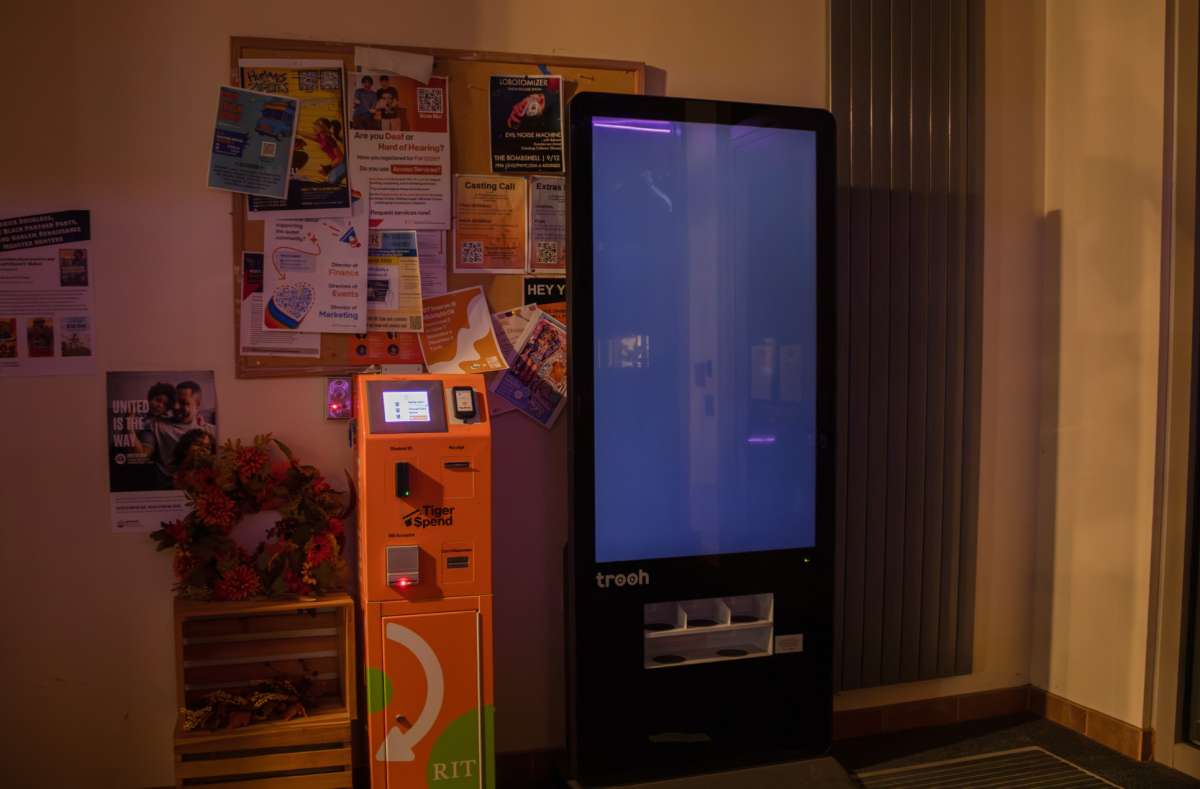
At the start of the fall semester, three digital screens appeared across campus displaying more than just regular campus flyers. The Trooh screens show horoscopes, music charts and other advertisements.
In Grace Watson Hall, students can find one located across from Beanz and Gracie’s. The second screen is located in Global Village, nestled between the Market and the Patio at Global Village. The third screen is located along the far wall of the seating area attached to RITZ.
What is a Trooh Screen?
According to the Trooh website, Trooh digital screens serve as an out-of-home media and communication network designed to reach Gen Z on college campuses. They are currently the only media network serving college students in the country, and have expanded to more than 1,000 college campuses in North America since their launch in 2016. The company pays for the installation of them on campuses.
These screens are designed to be placed in high-traffic, non-academic locations such as dining halls or student unions. At the base of each screen are built-in charging ports and wireless charging pads free for students to use.
The screens are set to cycle through campus announcements, weather, news, pop culture content and brand advertisements.
Why Are They Here?
The Office of Experience and Communications was offered the opportunity to bring Trooh screens to campus. After contacting other universities with the digital screens and receiving positive feedback, they decided to move forward with the decision. The office worked with Trooh to establish advertising restrictions, such as prohibiting alcohol and tobacco advertisements. These Trooh screens were then installed across campus on Sept. 10, 2026.
Shauna Cross, the Executive Director of Experience and Communications, shared the benefits of bringing the screens to RIT. Unlike any other digital screens on campus, the Trooh screens can be used to share important information within 15 minutes, or even scheduled in advance. According to Cross, the office anticipates this feature being used to “help reinforce campus-wide messages such as pedestrian safety, or quickly share an unexpected dining closure, a change in service, or even a pop-up event or giveaway.”
Trooh paid to install the screens on campus, so RIT incurred no installation costs. In turn, RIT takes a 15% share of advertising revenue. That money is given back to the Office of Experience and Communications, who use it to enhance student experiences.
“The intent is for the value created through these screens, including the revenue they generate, to support work that benefits the campus community and student experience,” Cross explained. In addition to the advertisements that rotate through, RIT gets 40% of the screen time for campus content.
Student Opinions
Students on campus shared mixed opinions about the screens. Bridget Kelly, a first-year biotechnology major, noted a disconnect between the content displayed on the Trooh screen in RITZ and relevant topics currently making headlines.
“I don’t really pay attention to them much. When I glance over, it’s horoscopes, which I personally don’t really care about. I’ve noticed music top charts. … It doesn’t seem like the most important thing. I don’t think I’ve ever seen any super important information on there that I’m like, oh, wow, I’m so glad I was here to see that screen,” Kelly said.
Others pointed out how the screens seemed out of place and didn’t have content reflective of the interest of the student body. “It feels out of place. It feels like a little alien sculpture in the middle of RITZ. I think a lot of the stuff that they put on the screens is not really aimed at the actual RIT students, just kind of aimed to appease whatever company put this up,” said Jessie, a third-year psychology major.
Others don’t seem to mind the screens and often tune them out. Second-year Industrial Design major Kendra Balcom stated she wasn’t impressed with them. Balcom works at Beanz and sees the screen in Grace Watson Hall frequently. According to Balcom, “sometimes it passes the time and is something to look at.”
Overall, students seem to be unimpressed with the screens and feel that the content does not reflect their interests or priorities.
Cross’s team welcomes this input from the student body as they continue growing used to Trooh screens. “We are still in the early stages, and we appreciate students asking questions and sharing feedback. That input will help us learn how to make the screens as useful and relevant as possible for the RIT community.”


