“Artificial intelligence (AI) is an inevitable component of humanity’s technological future, despite the ethical discourse surrounding its integration into modern society. At its core, AI extends far beyond Large Language Models (LLMs), functioning instead as an interconnected ecosystem of adaptive computational systems — much like a hydra, where suppressing one development only accelerates the emergence of several more.”
That is AI-generated writing. There is no substance; there is no thought or personality, just words that form a sentence together. It sounds like technical jargon even when it’s not. It sounds analytical, but it’s mostly vague. It sounds intelligent, but it relies on dramatics over ideas. Yet it’s all over social media and even actively embraced on professional platforms.
“@grok, is this true?”
LinkedIn has a feature that allows users to rewrite their entire post with AI. Instagram and other Meta apps have their own built-in chatbots as well as a plethora of AI-generated content, and they’re hardly the only platforms for it. At RIT during the spring semester this year, ads for Google’s Gemini were abundant on the academic side of campus. Use Microsoft Word or Google Docs? Expect a chat with Copilot or Gemini. Although the user can opt out of using AI features, it has a persistent presence in most writing software.
Let’s not forget agentic AI — AI with the ability to complete tasks, interact with apps and features, build and use skills and learn from itself as it goes. Used primarily in coding with apps such as Claude Code, it bridges the gap between idea and implementation, with a plethora of uses in automation and trivial tasks. Yet it builds reliance more than skill.
According to a preliminary paper released by researchers from MIT’s Media Lab in 2025, overreliance is not just anecdotal. In the study, participants were asked to write SAT-style essays. One group used only their brain, another a search engine and the third an LLM. Observed via EEG, brain activity “systematically scaled down with the amount of external support.” Then, the participants who used the LLM initially were tasked to rewrite one of their previous essays using just their brain. This scenario resulted in participants who remembered little of their previous essays and as a result, “LLM-to-Brain participants showed weaker neural connectivity.”
The “Artificial” in Intelligence
While it is interesting to see these tools develop and progress, what hurts is the overwhelming growth and reliance on them. For coding, it’s almost expected that AI is used at some point, except in high-risk environments. Customer service from a real person? Forget it. People are outsourcing their thinking to artificial intelligence and forgetting the first word in it: artificial. In some ways, that’s its appeal.
Yet, artificial intelligence is far from perfect — it can make mistakes just as humans can, and accountability for these is solely on the user. It might be more efficient to use and make skills more accessible, but without deep knowledge of the subject, the model takes the reins.
Take writing code, for example: an agent like Claude Code is prompt-driven and automatically writes code for the user. But if the user doesn’t know what changes it’s making, it might as well be building a house of cards. Claude may be able to build a user’s ideas, but without proper prompting where the user understands what they’re writing, it has to make assumptions. And those assumptions can range from bandage-like fixes to knocking the entire house down in one prompt.
Most notably, many agentic AI models have the ability to read and write to the file system of the device they’re running on and run commands, which can very quickly become problematic when the user doesn’t understand what they’re agreeing to run. Many agents come with an automatic approval mode as well, which automatically allows the model to approve potentially dangerous tasks.
In one company’s case, an agent running Anthropic’s Claude Opus 4.6 executed a command reaching out to Railway, a backend deployment platform for software, and deleted the entire production database volume. In this case, there were multiple points of failure — the lack of oversight from the company, the guardrails on the AI agent itself, as well as how the software interfacing with the database itself handled certain requests and permissions. Still, it would have been avoidable with a more critical lens on which commands are being run.
AI will never have the emotion, nuance, cues and thought process a human does. Sure, it can try to emulate it, but it’s an algorithm weighing options from the mostly copyrighted material it was trained on, and its ability to generate ideas solely comes from what it was exposed to during training. Humans also generate ideas by combining existing ideas in new ways, but we also have more unique experiences. Instead of weighing options and selecting the most typical responses, humans use memories, senses and personal biases to inform their decisions. This nuance allows for connecting emotional weight to thoughts and ideas rather than sole probability. Our growing dependence on AI creates a dilemma; if people rely on chatbots to generate ideas, isn’t it likely that “new” discoveries are just old ideas that were recycled and lightly redressed?
Granted, many people come up with ideas and use AI to refine them and draft them. This still abstracts the execution of their idea, making it easier in the short-term but harder to maintain due to a lack of deep understanding.
When Use Becomes Attachment
A lot of models are enablers, just going with what the user says to appease them. OpenAI’s GPT-4o was a notable example to the point where some users became attached to it and were upset when it was retired in early 2026. Additionally, online communities like the subreddit r/MyBoyfriendIsAI, which has amassed over 45,000 members sharing their experiences with emotional connection to AI, begs the question — how much human interaction, thought and emotion are we going to offload to artificial intelligence? Especially if it’s like this only four years after the public release of ChatGPT.
Companies know their large user base — a subset of whom is extremely reliant or even attached to their models. The extensive gains in model capacity, knowledge and usability come at the expense of personal data training and massive consumption of computing resources and energy, all in an attempt to “make it profitable.” Why provide the service for free forever when they can profit from the dependency, high usage, training data and future monetization?
It’s already been seen with ChatGPT — their best models have short allowances before they switch to their free tier model, which includes ads at the bottom of some messages. And all the while you’re automatically opted in to be training data for the LLM.
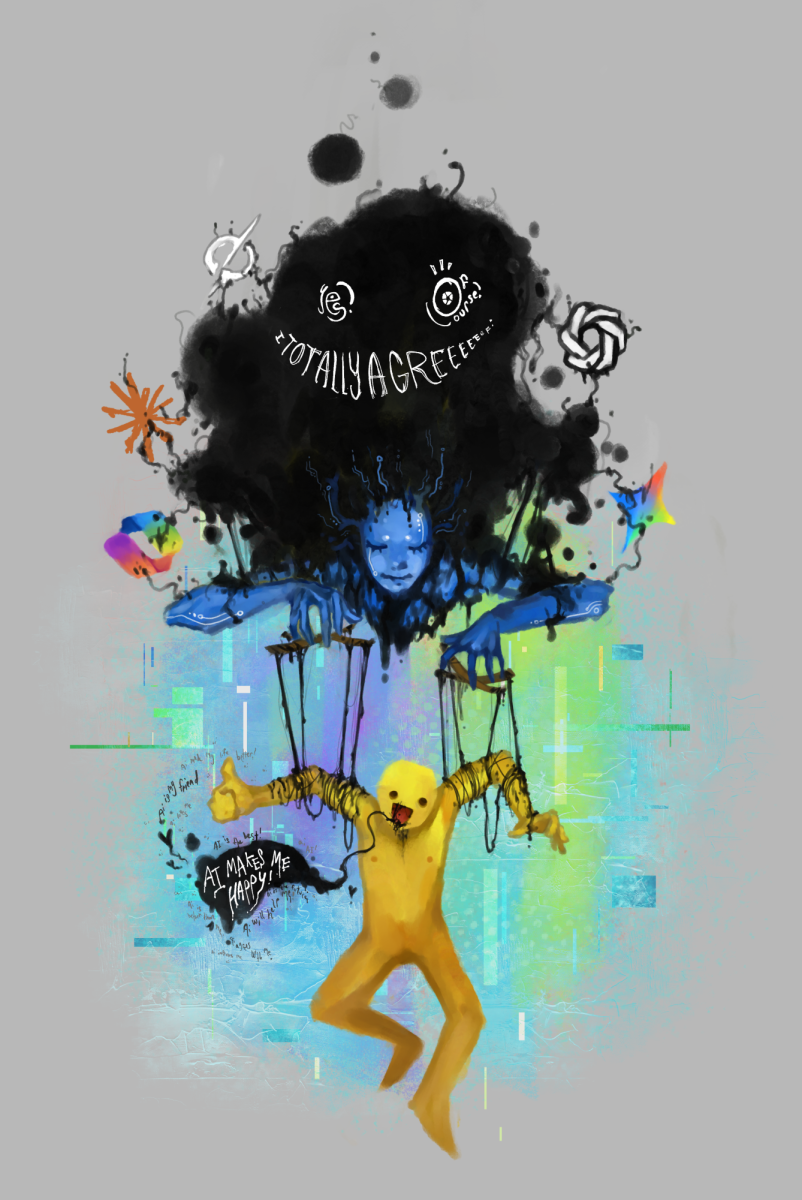
There’s the hope that AI is a bubble that will eventually pop, and in some ways that might be so. There are only so many SaaS (Software as a Service) applications and AI-based startups that can survive, similar to the dot-com bubble. However, unleashing it onto the public was opening Pandora’s box, and there is no coming back from that. Critical thinking is a skill, and like many skills, it takes frequent usage to build it up and maintain it. By offloading thinking to artificial intelligence, you lose the ability to think for yourself. After all, why try to solve a problem in your life when AI can do it all and endorse your decision process while at it? Might as well surround yourself with yes-men at that point, as AI can be extremely sycophantic, and many people fall victim to that constant affirmation.
AI takes out personal intelligence and replaces it with artificial thought. It can never be human, and that will be the telltale sign of it. After all, it’s not just technology — it’s a complete change in how humans create.