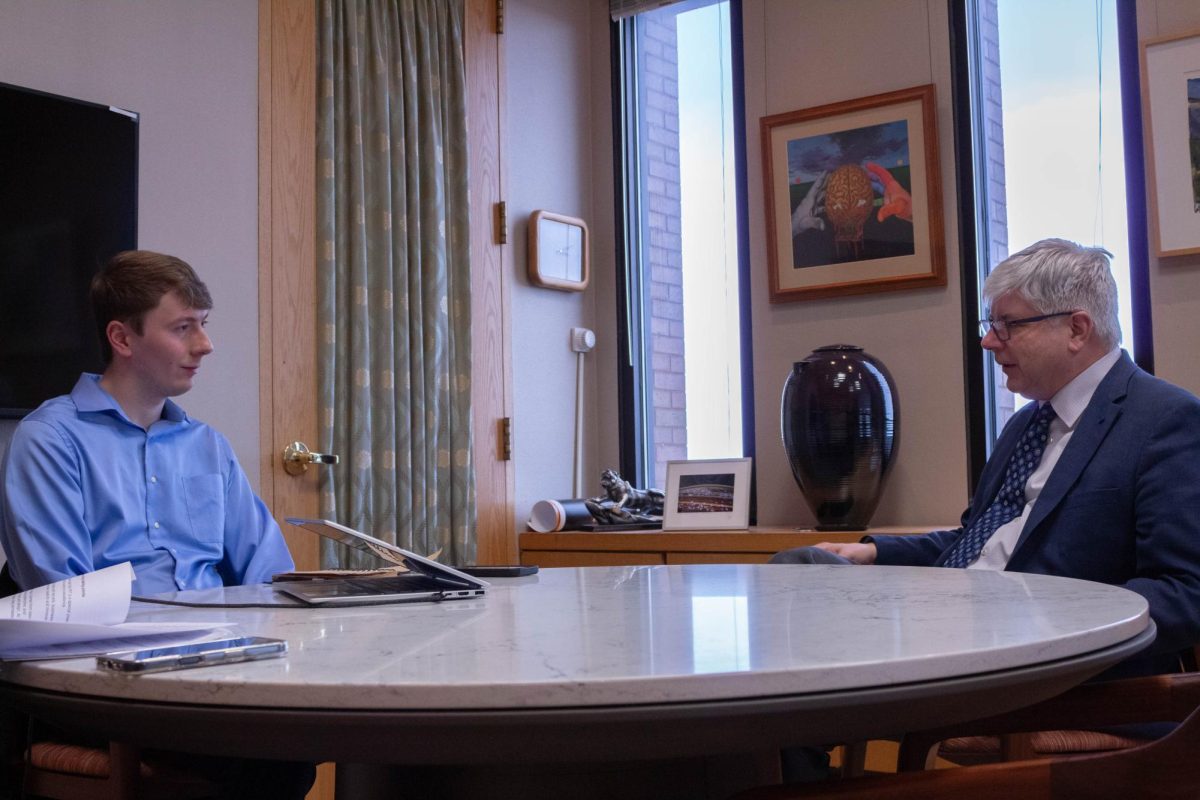
What is something you’ve learned about RIT throughout your first year that you didn’t know when getting started as president?
I may have thought I knew this, but I didn’t fully understand how wonderful the people are — the students, staff, and faculty. They’re dedicated, welcoming, and supportive of each other.
It’s an amazing place built on people. I was welcomed from day one, but that’s even clearer now. This is a place on the move. We’ve done a lot in eight months, and there’s more to do.
Recently, RIT’s new strategic framework was released. How would you summarize that framework to the student population at RIT?
It’s a North Star, a vision for where we want to be in 10 years and a roadmap for how to get there.
We have strategic goals and actions, but they’re broad enough to allow innovation. That’s a departure from past plans, and the plan is much more about what people will do and what we’ll achieve together, rather than creating a building. Now the focus is on people and programs.
Every one of the four pillars connects to students. The first, transformative educational experiences, builds on co-op and expands experiential learning. It also includes new programs, like AI.
The second pillar, world-changing research, focuses on making a difference. It’s important to know that it’s not just about research for the sake of educating students. It’s for research to make the world a better place. Students will have more opportunities to participate, including undergraduates.
The third pillar, well-being and community, pertains to everyone, but the well-being of students in our community is a big part of it.
The fourth, global mindset and presence, builds on our international campuses and programs. On one end, we want to build upon, be respectful of and embrace the local culture in each place we are. And then on the other end, we want to transcend boundaries.
Our student government got together with the student governments from our Dubai, Croatia and Kosovo campuses, and they met in Kosovo and talked about how they would work together. I think that’s really great, and I know they had a lot of fun too.
There’s a lot in the plan — more than can be covered briefly.
How does RIT plan to advance research for students and faculty going forward?
There are several approaches. We already have funded programs supporting student research, including summer opportunities through NSF.
We also have IGERT programs that provide research-focused educational experiences, such as in microelectronics.
From a practical point of view, undergraduate students are increasingly joining research groups and working with graduate students and faculty. That’s continually growing across varying programs and colleges.
On the faculty side, we’re continuing to build infrastructure to support research. Our faculty are great. Those who want to spend all their time teaching, we’re very supportive of that. Those who want to become more and more active in research, we support that too.
RIT recently announced the addition of a Bachelor of Science degree program in AI. How do you believe this development will impact the university’s academic curriculum going forward?
This is a great development. We’re not the only ones doing this, as some other schools have already announced AI undergraduate degree programs. But we have moved very quickly to put this in place.
It’s been in discussion for some time, but I can tell you that we accelerated its introduction at RIT. We thought it might be fall of 2027 before we could introduce it, but I’m really thankful to both our faculty governance and our processes for reviewing and approving new programs within RIT, which move this around very quickly. I’m incredibly thankful as well to the New York State Higher Education Board, which approved the program in record time, just 20 days after we sent it to the state to be approved. And this normally could take months.
That timing allowed us to announce the existence of the program at key times when students are making enrollment decisions. Even those admitted to other programs in GCCIS will now have this option.
I think we’re going to start the program in a soft way. I don’t know the exact number of students they intend to admit in the fall, but this will allow us to ramp up the program and do it really quickly. This is a program for those who wish to understand AI from a technical point of view.
We also have a whole variety of other programming related to AI coming on campus. This is part of a larger overall strategy to teach AI not just from a technical point of view, but also from a business point of view and a social and ethical point of view, because we believe they all go together.
What would you say to any students who might have reservations about this AI curriculum or changes coming to RIT’s academic curriculum?
For the AI curriculum, only those students who are interested in it are going to take it. If there is a student who believes we should not be doing work in AI at all on campus, I would say to them that I believe this is the future.
I believe one needs to approach the use and the teaching of AI within strong ethical constraints. This is why we have faculty from many colleges working together. AI is not owned by any one college, and we have our liberal arts faculty, together with our technical faculty in both engineering and computer science, thinking about how AI should be taught.
AI is happening, and AI is changing how we work. People call it the future of work. We want to be the ones who drive that change in a socially responsible way, rather than be the ones who are affected by changes that others make.
That’s why it’s so important that our students are leading this transformation of work that will occur through AI.
What partnerships and developments are being made with local businesses and institutions, specifically in the health tech field?
There’s more to come. We’re expanding clinical degree programs, including occupational therapy and future programs in nursing and physical therapy.
These programs combine clinical training with technology, preparing graduates for modern healthcare and innovation in the field.
We have a long-standing partnership with Rochester Regional Health, which provides clinical training opportunities.
We also collaborate with other healthcare providers, biomedical companies, and universities.
If you had to choose one, what decision or change from the past year do you feel had the biggest impact on students?
We’re still focusing co op flexibility for students. As we know, the work environment is challenging right now. We’re working to ensure every student can find a meaningful experiential learning opportunity.
Some colleges offered summer research options for students who couldn’t secure co-ops. We’re formalizing these changes and letting the needs of students and their advisors flexibly guide us in figuring out how to best support them.
We’re also working on other initiatives, such as those related to making it easier for students to switch between majors and expanding minors and immersions.
This challenge for students to obtain internships and co-ops is nationwide, right? Quite frankly, I think we’re much better off because of the infrastructure we have at RIT than at other schools.
We’re taking all of this into account, and one of the strategic actions of the new framework talks about building a co-op and building experiential learning for the next 10 years. So it’s in motion.
Could you provide any updates on the implementation of some policies that were advocated for by students?
There hasn’t been a single major policy change driven by Student Government. Instead, we’ve built a strong, ongoing partnership with Student Government’s president and several members of their executive committee. It’s less about a specific thing where they came and demanded a change, and then we made a change. It’s more that we’re in conversation together constantly.
In many cases, the Railroad Club being one of them, students advocated through others about spaces, and I think that situation is more due to a misunderstanding between Student Affairs and some of the clubs, rather than a strong change in policy. But we very much support clubs on campus, and Student Affairs has committed that they will understand and meet the needs of clubs before they move.
I believe that the club and Student Affairs now understand each other and are working well together. I think that communication is how a lot of these issues get solved, and my job really is to facilitate that communication.
What trends would you say you’re most focused on right now in higher education, particularly in the United States?
One crucial area is federal funding. Despite worries about the loss of research funding, the budget for 2026 was approved, and it was approved with the funding for all the major research agencies, the same as it was last year.
Longer term, a key trend is the decline in college-age populations in the Northeast, a prediction of a loss of about 20% there, and our reaction to that. In response, RIT has expanded nationally. We have results showing that expansion is working, and we have significant growth over the last 6 years in the number of applications for states other than New York. Applications have grown significantly, from about 32,000 to over 38,000 in one year.
We’re seeing growth from states like Texas, California, Illinois, and Massachusetts. About 40% of incoming students are now from outside New York. We are becoming a national brand. Essentially, we will thrive as a university by developing a unique, strong brand that will buck the averages.
Are there any updates on international student enrollment, and how does that factor into RIT’s long-term planning and framework?
International student applications are down this year, and from a fractional point of view, they’re down quite a bit.
For international undergraduates, there are few international students to begin with (currently around 500 international undergraduate students).
The fraction of students who applied to the Master’s, PhD and other graduate programs that are international is much more significant, on the order of half.
Our master’s student applications are down by 40 or 50%, and our PhD applications are down by about 3% (from typically comprising around 50% of graduate students).
For Master’s applications, that decrease is largely due to international students, but it’s being offset partially by the flow of students to our Master’s program from our accelerated combined Bachelor’s and Master’s programs, and that will help us significantly going forward.
About a third of our incoming first-year students now say they want to go on for a Master’s degree. That development will provide us with a strong flow of domestic students for our Master’s programs going forward.
Our PhD programs are also quite competitive. We typically accept less than 20% of PhD students who apply. Although applications are down a little, there are plenty of strong PhD students to drive forward our desire to become a more research-intensive university.
While the reduction in international students is real, we’re not impacted as much in comparison to other schools, partially because the fraction of international students in the undergraduate program was relatively small to begin with.
The Master’s program is being offset by the combined accelerated Bachelor’s-Master’s program, and in the PhD program, we were quite competitive anyway, so there’s still, in most fields, a good number of very high-quality students.
What are your top priorities for your second year as president?
The first year was all about learning, and I focused on learning and building relationships. Of course, you never stop learning, so I’m going to continue that.
Having said that, the completion of the strategic framework is a major milestone. And so we’re going to move into a phase in which, strategically, we’re going to create new initiatives that support this strategic framework.
Early efforts will include an AI initiative in health and technology, and a focus on student well-being, retention and graduation rates.
We want to make sure we know that every student who comes here can thrive here. But we know that too many of our students, for one reason or another, don’t persist. That’s something we’ve made a priority as well.