When I first heard news of the Backrooms movie in production, I was admittedly worried. So much of Backrooms media nowadays has been sanitized into games with countless repetitive levels, screaming entities and convoluted lore that stray so far from the original post and comment that inspired the concept –
“If you’re not careful and you no clip out of reality in the wrong areas, you’ll end up in the Backrooms, where it’s nothing but the stink of old moist carpet, the madness of mono-yellow, the endless background noise of fluorescent lights at maximum hum-buzz, and approximately six hundred million square miles of randomly segmented empty rooms to be trapped in. God save you if you hear something wandering around nearby, because it sure as hell has heard you.”
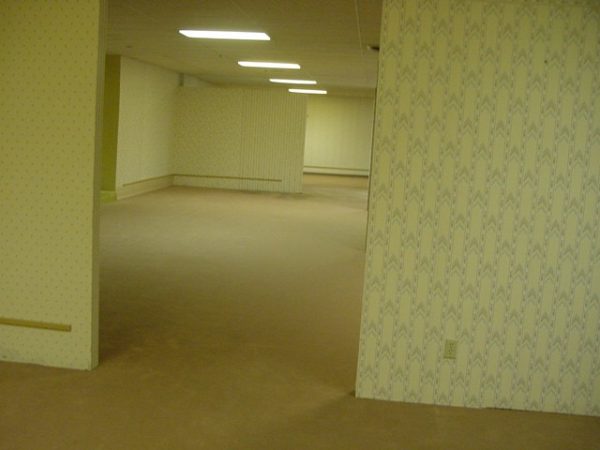
The entire point of the original concept of the Backrooms was the fear of the unknown. You’re trapped in an endless maze that feels strangely familiar, yet just different enough to feel a sense of unease. Maybe it’s the strange shape of the room, or the fact that furniture, if there’s any at all, is askew, but you get the sinking feeling that you shouldn’t be wandering the chevron-covered halls. Rather than the fear coming from an entity or monster, you’re left questioning whether or not you’re alone – and whether or not you want the answer to be yes or no. This simple, yet terrifying concept has been reworked over and over again in games, so that now, the only identifying concept linking them together is that same sickly yellow maze the games often start in.
Not everything needs to be overly complex and interwoven with lore, and in doing so, we strip the liminal aspects of what truly makes the Backrooms concept so terrifying. My fear was that the film distribution company A24 would do just that in the new Backrooms movie. But then I watched the trailer, and it looked like a far cry from other Backrooms media. With all of these doubts in my mind, I bought myself a ticket and took my seat in the dimly lit theatre. And by the time the credits rolled, I was surprised by just how wrong my first impression had been.
**SPOILERS AHEAD**
Behind the Lens
I think it’s important to start with the glaringly obvious – Backrooms is not for everyone. I’ve heard many people say that the movie was “slow” or “boring,” though I completely disagree. So much of modern horror has become oversaturated with constant stimulation through fast-paced plots, overt jump scares every few minutes and storytelling so on-the-nose that nothing is left up to interpretation or imagination. A film like Backrooms, with its slower, more atmospheric approach, can feel unfamiliar to audiences because it is.
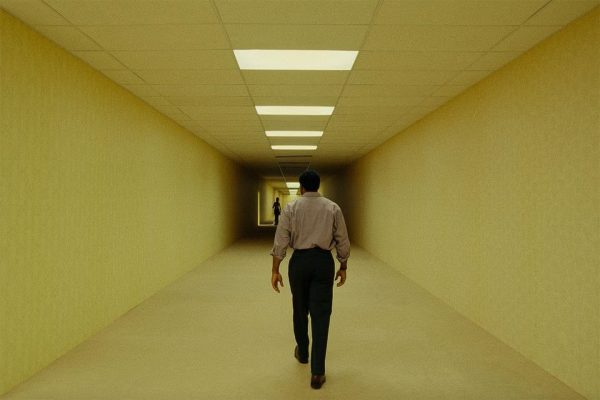
Instead of focusing on action and conventional horror, the movie builds its tension and fear entirely through its setting and atmosphere. Rather than rushing through each scene, the movie is filled with slow panning shots that really allowed me a chance to get a feel for the environment. Every moment highlighted the sheer loneliness and existentialism of the Backrooms, and I loved the consistent shifts between first-person and third-person perspectives. I felt fully immersed in the moment, and even though the film was set in a muted yellow labyrinth, I still felt every bit of fear and dread that the characters experienced.
What surprised me the most, however, was the sound design of the film. Backrooms Director Kane Parsons, who also created the Backrooms YouTube web-series, incorporated his own music into the movie, editing and distorting the audio just enough to sound familiar, but more eerie and unsettling. That same feeling carries over to the film’s sound design, where warped, ghostly cries slowly build in tension and distorted synth wails create a sense of panic as the protagonist is chased by the monster. I genuinely had never heard anything like it before, and I still remember the strange pit in my stomach as those sounds filled the dark theatre.
The Story of Backrooms
When interacting with Backrooms discussions online, the biggest issue I’ve seen viewers have with the film was its plot. Many say that Backrooms was “confusing”, and while I understand what they mean, I do think that that’s the whole point. Rather than relying on heavy exposition that explains the entire premise, the film leaves its meanings up to interpretation. The concept of Backrooms can mean different things to different people, and I believe that its ambiguity is what makes the movie so interesting. Some view the Backrooms as a cosmic entity, while others view it as an allegory for generative artificial intelligence. While I believe that each answer holds its weight, I view the Backrooms as a representation of fragmented memories.
Oftentimes, when we look back on certain memories, time can erode and distort them, causing us to forget and misremember events and places. And I believe the Backrooms take that to another level by physically manifesting those fractured memories.
Clark, an aspiring architect and struggling owner of Cap’n Clark’s Ottoman Empire furniture store, serves as the false protagonist of the film. He explains to the protagonist, his therapist, Mary, that the Backroom serves as a place of memory and that “the more times it remembers something, the less it does.” There’s a sense of familiarity and recognition to the layout and objects in the Backrooms – buzzing fluorescent ceiling lights, worn-out wooden furniture and that same yellow wallpaper that one might find in their grandparent’s home. Yet the halls seem to stretch farther than they should, and the corners feel less like turns and more like a trap.
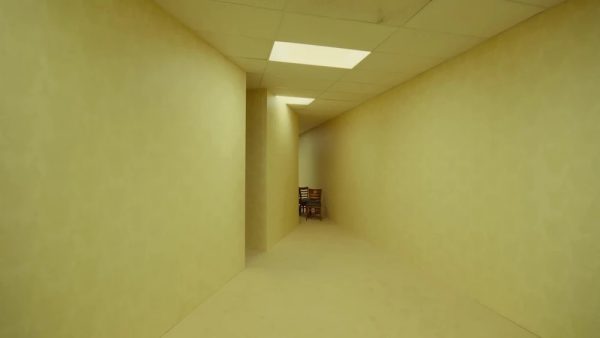
And it’s in those memories that Clark finds himself trapped. Before starting his therapy with Mary, Clark lived with his wife Barbara, who was in college to become a lawyer. Clark served as the breadwinner for the two of them, paying for her college fees while also managing his furniture store. This financial stress eventually led Clark to harbor resentment and anger towards his wife, and one night, after stumbling home drunk and getting into an intense argument with Barbara, she kicked him out, forcing him to live a life of solitude in his furniture store.
When discussing his predicament with Mary, Clark seems almost defeated, stating that “I hurt people. I don’t want to. It’s just the way I’m wired. So, maybe I deserve to be alone.” Even though Clark understands how harmful his behavior is to himself and others, he continues to wallow in a sort of self-deprecating state and instead chooses to blame the world around him for his own problems.
As Mary quotes at the beginning of the film, “We all have our loops, our habits. Behaviors that keep us walking in circles, reaching for the same solutions over and over again, thinking each time will take you somewhere new. But they don’t.”
Much like these loops, Clark’s constant victim mentality leads to him putting others in danger and rationalizing violence against people in the film. To show proof of the Backrooms, he drags his assistant manager, Kat, and her boyfriend, Bobby, along with him, despite knowing the dangers it posed and how reluctant and fearful Kat was. Rather than go down a long sloped corridor in the Backrooms, he ties up Bobby and makes him go instead. I’ve seen many theorize that Clark intentionally tied the knot so that Bobby couldn’t escape out of fear, which would explain why, before being dragged down the slope and killed, Bobby struggled to untie it, and even asked what kind of knot it was. Towards the end of the movie, he even decapitates Kat, though we’re never explicitly told why, and stores her head in a fridge, explaining that he “tried to help her.” I also believe that the movie implies that he even abused Barbara, seeing how her still-life, an entity resulting in the Backrooms attempting to replicate people, seemed to run up to him, clutching her head and stumbling as if she had been hit. The still-life is never clearly stated to be Barbara’s, but when Clark introduces the rest of the still-lifes to Mary, he vaguely gestures toward the redhead, and looks at her almost forlornly. The still-life seems to be a stand-in for Barbara, as we see a similar-looking redheaded woman in a photo with Clark earlier in the movie.
Though near the end of the film, Mary grew tired of his victim mentality, stating that it wasn’t Clark’s drinking, his late-night arrivals or his anger that made her leave him. “It was the whining,” Mary said. “Nothing’s ever your fault, is it?” For a moment, Clark went quiet, and we’re left with a glimmer of hope that the realization will hit him. A single tear rolls down his cheek as he whispers, “I don’t think I want to change. I like it in here. For the first time in a long time. I feel like I’m right where I’m supposed to be.”
After this, Captain Clark, a twisted and disfigured replication of Clark, appears, with Clark telling him, “…we don’t need to change. It’s just the way we’re wired.” In an almost ironic interpretation of Saturn Devouring His Son, Captain Clark sinks his teeth into him and slowly devours him.
There are many interpretations as to why Captain Clark kills Clark after being somewhat docile to him for so long. I like to think of Clark’s death as a physical manifestation of his actions, and maybe even guilt, consuming him. He was quite literally consumed by himself.
Clark embodies many of the same qualities as the Backrooms: He’s trapped in a never-ending cycle of self-destructive habits and was imprisoned by pity and grief, leaving him a lonely shell of a man. And he accepted that he’ll never escape. As Mary explains in the beginning of Backrooms, “You learned to push people away, before they could hurt you. And now, as an adult, you’re still stuck right where you started. Alone.”
Backrooms is obviously not a perfect film; I have a few issues with plot gaps in the story, and it could benefit from a few extra minutes of runtime. However, A24 have released Backrooms: Everything Must Go Edition, which features 15 minutes of extra footage, on July 3, which will most likely address the miniscule problems I had with the film.
Overall, I loved Backrooms and it was a huge breath of fresh of air among modern horror movies released in recent years. The characters felt so real and genuine, and Clark’s sorrowful dinner-table monologue definitely brought a tear to my eye. If Backrooms and Clark have taught us anything, it’s to not wallow in the past, but instead to take the initiative to change the aspects of ourselves that are holding us back from truly living life. Unlike the Backrooms, our lives aren’t infinite, so we should make the most of the time that we have rather than wasting it trapped by our mistakes and regrets of the past.