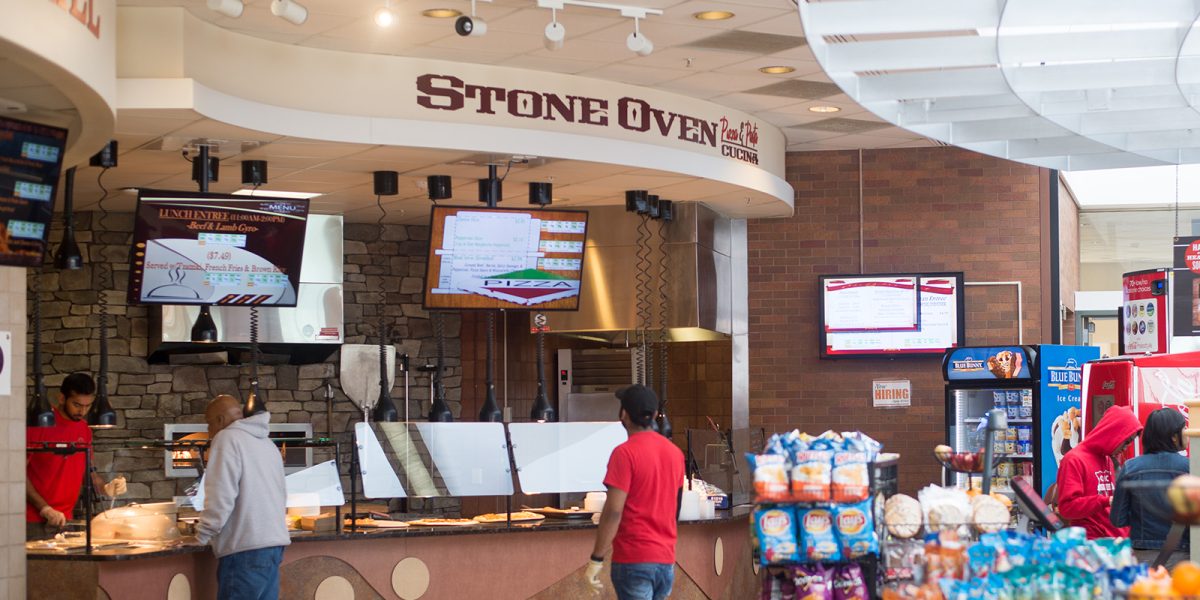
Near the beginning of the 2025-26 school year, the student body was shaken as the news of The Commons’ closure broke through a leaked email and the subsequent official announcement from RIT Dining. A PawPrints petition to Student Government was set up nearly immediately, and this attempt appears to have paid off, working in tandem with the attempts from RIT Dining themselves to prevent the closure.
The Student Perspective
Spencer Marchese-Ragona — a fourth year Film Production student and the poster of the PawPrint petition — stated, “I was not surprised by the amount of support, but I was very pleased.”
Marchese-Ragona had responded to the announcement of the closing with a short email that linked to the petition. A month later, he met up with Dustin Peterson — the Director of Operations-Retail and Partnerships at RIT Dining — and Karla Orozco — the Interim Executive Director of RIT Dining. He said they filled him in on plans to convert to online ordering only, and explained that customers at Commons were much fewer than for many of the other on-campus dining options. They said that, for instance, the Kitchen at Brick City lunch patrons were on average 1600, while Commons had only 400.
He added, “I pressed further and obtained Gracie’s numbers: 100.”
Marchese-Ragona also expressed concern that the downsizing of Commons would reduce the communal spaces available for Deaf individuals to hang out in. He stated that while Gracie’s is still an option, the all-you-can-eat dining hall has “a significantly higher barrier to entry compared to all the other dining locations.”
The Administrative Perspective
Dustin Peterson explained that, for Dining, the priority had been to find a way to remain open while still creating a solution to financial issues.
“We were able to make some really good wins, I think so far, with expansions down at the grind to increase services down there and options, and then, you know, the mobile order kiosk model that we rolled out. That’s a huge win.”
Orozco and Peterson explained that the change to Commons was part of a bigger move toward providing different methods of dining.
Orozco stated, “Dining has not expanded in terms of the number of operations, but it’s shifting into different model services. So we have the convenience stores, we have the retail, we have the all you care to eat. Now you have mobile and kiosk-only ordering, and then you have the micro markets.”
Additionally, they described how the decision had been made to downsize Commons rather than Gracie’s, despite students’ complaints that Gracie’s has less convenient hours and different food quality and options. According to them, in the past, Gracie’s has often been used as overflow housing during issues like mass power outages or pipe leaks. Removing Gracie’s would eliminate that potential. Additionally, Peterson explained that as a school with a Division I hockey team, many students are looking for buffet-style, all-you-can-eat dining options.
Primary changes to Commons thus far have been the transfer to a kiosk-based ordering system and a change in hours to opening at 2 p.m. each day. The menu has also downsized somewhat, erasing visiting chefs altogether for the time being — though Peterson stated he hopes to bring them back in the future.
Though Commons is certainly different from how it was previously, RIT Dining appears to have been receptive to students’ desire for it to continue operating.