
Pro – Miles Better Than Before!
By Hannah Meyer
The RIT shuttle system’s quality is a constant point of contention for students on campus.
The bus system at RIT has greatly improved in comparison to two semesters ago. I was on co-op in the spring, so I can’t compare my experience to how the bus system was last semester. As someone who lives on campus at Perkins Green, I use the bus system to get to class daily.
What Happened?
During the fall 2024 semester, bus routes were significantly altered. A lack of available buses because of breakdowns led to bus routes to student housing being combined. There was a combined Perkins Green, 175 Jefferson and Park Point bus with a whopping six stops every 25 minutes on its route. There was also a combined Apex/Province bus for students, repeating its route every 20 minutes.
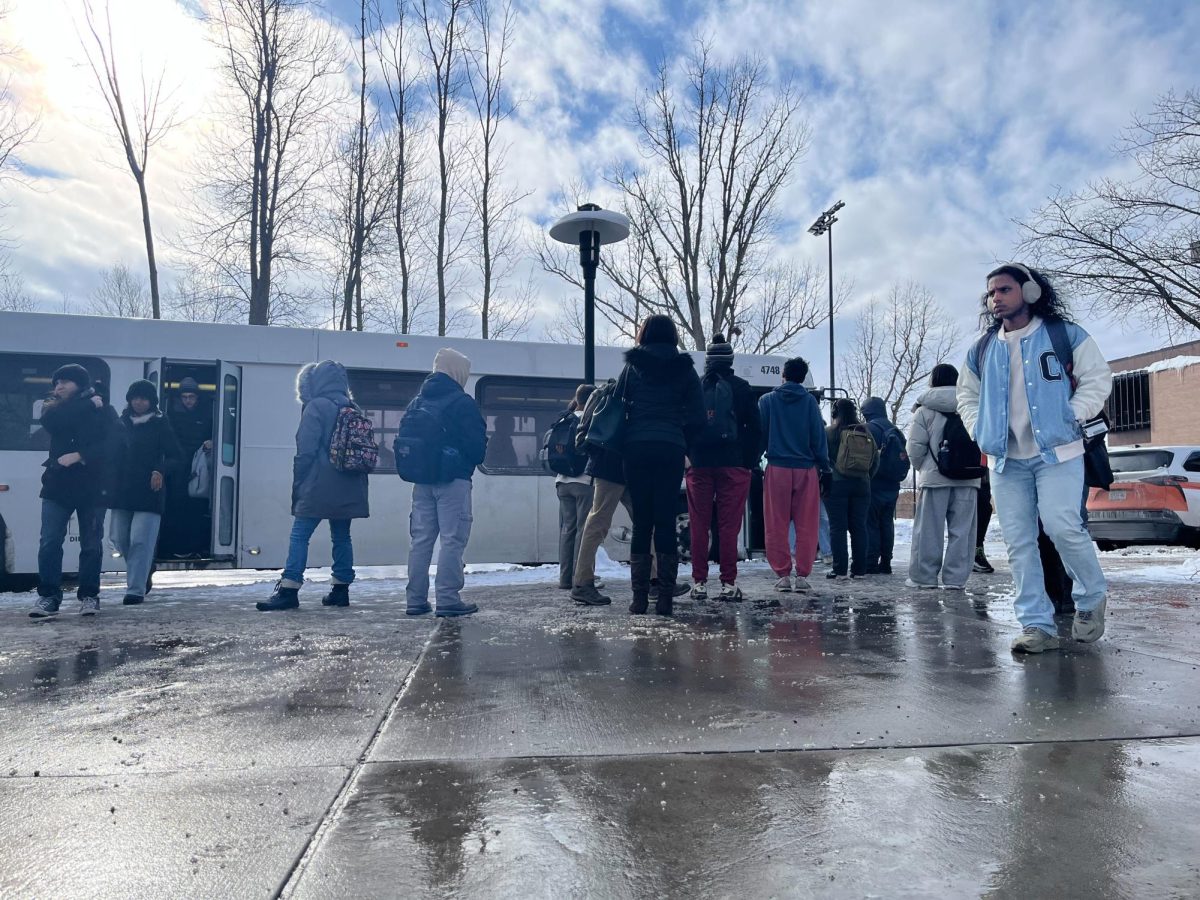
These combined bus routes led to long wait times and extreme overcrowding – buses could be seen leaving many students behind at the stop once the bus reached maximum capacity – resulting in frustration from the student body. This also led to many students having to stand in freezing temperatures without access to a heated bus stop, such as at Perkins Green and Park Point South.
What’s Changed?
For the fall 2025 semester, RIT has offered 10 different bus routes traveling to both on and off-campus housing locations, a route connecting students to a Regional Transit Service (RTS) and a weekend retail shuttle.
Sean Haughton, a fifth year Mechanical Engineering Technology student and member of Urbanism at RIT, says, “I’m happy that the buses are actually running this semester.”
Madison Mendes, a fourth year Biomedical Engineering student, rides the shuttle system daily and has noticed improvements. “The buses are a lot more consistent compared to last semester,” she explained. “They stick by the time schedule a lot more.”
This new, notable consistency could be since RIT changed bus providers over the summer, from First Transit to WeDriveU.
New Solutions
Additionally, the TripShot app can be utilized to follow the bus’s location in real time. An article provided by RIT allows any student to add the shuttle system tracker app to their phone.
TripShot provides more accurate information in comparison to the previous bus tracking app, PassioGo. PassioGo had issues displaying the live location of the bus, which was also an issue that University of Rochester students struggled with.
TripShot is also a helpful tool when the bus is running slightly behind or ahead of schedule; by watching the bus move across the map, I can prepare to leave my house before the bus arrives at my stop. To students who are having issues catching the bus on time, I recommend using the app!
There is also a shuttle tracking website, Ritchie’s Bus Schedule, developed by fourth year Software Engineering student Hiroto Takeuchi. The website shows which bus routes are actively running, and how many minutes/seconds are left before the bus departs. Students can select a favorite bus route, which pins the selected schedule to the top of the website.
Of course, the bus system isn’t perfect, and there is still plenty of room for improvement. For example, many students are still hoping RIT will reimplement a previously offered bus route to downtown Rochester for those without cars.
However, the small improvements in the RIT bus system seen thus far are enough to demonstrate that positive change can continue to occur. Due to the positive changes implemented, I will continue to utilize the improved RIT shuttle system along with the TripShot app in my daily commute.
Con – Still Leaving Students Disconnected
By William Walker
Last year, RIT’s shuttle system broke down following a series of failed bus inspections. Vehicles from the University of Buffalo were borrowed to support basic day-to-day operations. Many of these failures coincided with the end of FirstTransit’s contract and were addressed with RIT’s new contract with WeDriveU. Additionally, minor route adjustments were made in an attempt to better connect students. Despite operational successes this year, RIT’s bus system still lacks the connections needed to serve the student body.
A Link to Downtown
RIT’s campus sits seven miles outside downtown Rochester, yet the urban region remains an important area for RIT students to access. A variety of event-based buses into the city highlight just some of the many reasons students venture into the city.
In the past fall semester alone, RIT provided Fringe Festival shuttles; CAD Honors Program organized First Friday buses each month; College Activities Board (CAB) sponsored a popular “Trip to Hamilton”; RIT Wellness provided a weekly morning round-trip to the Public Market; and both CAB and Into the ROC provided immensely popular buses to the Strong Museum of Play — an event which routinely receives between 400 and 700 registrations. In past semesters, the Performing Arts Scholars Program regularly sponsored buses for concerts. The spring semester brings just as many shuttles for students’ many interests. Without a singular downtown bus in the shuttle system, various departments have shouldered the responsibility and cost of transporting students to and from the city.
Despite the popularity of transit options for scheduled events, reliable service for students remains elusive. The overdependence on event-specific buses neglects other reasons students would travel into the city. Students living off-campus near Rochester need regularly scheduled transit. Countless theaters, bookstores and thrift shops provide cultural and social attractions, and older students enjoy Rochester’s bar and brewery scene. Many other niche events and locations students wish to visit go overlooked when treating off-campus transportation this way.
Problems With Existing Routes
The demand for a regular and reliable bus route into the city is evident. Downtown Rochester is RIT’s largest cultural touchpoint, yet students without cars lack convenient access to the city. Currently, their only public transit option is RIT’s RTS Connection to RTS Route #41 — a route that was altered for better alignment in the new shuttle contract. With the shuttle transfer, students can reach the city in roughly 40 minutes on weekdays — around the same time it would take to bike there. On weekends, the combined route jumps to over an hour in length. The same trip by car only takes 20 minutes. Even with the updated timing, the route remains prohibitively long for students and staff, and the inconsistent transfer to RTS #41 discourages its use.
Beyond acting as a transit connection, the Weekend Retail Shuttle continues to restrict how students can spend their time off campus. With a single bus making a loop once per hour, the route forces students to extend their shopping trips. Last year, limited bus capacity contributed to serious overcrowding on retail buses. Although crowding has lessened, retail shuttles continue to see heavy ridership, which implies a need for expanded capacity and higher frequency.
Solutions
RIT must address students’ transportation needs at the administrative level. In the past, RIT provided the necessary service for students with a “Downtown Weekend Bus” and maintained a reliable connection through RTS. Recent PawPrints to resurrect the downtown bus have received sufficient support from the student body to merit a response. Student Government’s recent answer to these pawprints, “ROC The Block,” fits into the pattern of event-specific shuttles. Although Student Government hints at future weekend shuttles, the possibility seems dependent on whether enough students are willing to pay $10 for a round trip. Beyond the limitations of the Student Government budget, a direct connection to the city is important enough to expect coverage to be provided — like RIT’s other shuttles — through student tuition alone. In addition, other PawPrints highlight the ongoing demand for buses between RIT housing and the city, as well as to the airport on holidays.
I am happy to see the shuttle system running smoothly once again. Currently, the bus system’s continued shortcomings do not appear to be operational. Instead, the issues reflect administrative apathy with respect to student needs. With a new stage in RIT’s administration beginning, these improvements to the bus system should be prioritized to meet its potential as a service for students.