Student Government (SG) gathered on Jan. 23 for presentations on an Internal Committee Restructuring Proposal, Anti-Hazing Policy and SG Elections. Additionally, SG voted to appoint individuals to open roles.
Committee Restructuring Proposal
Director of Student Relations Trishelle Hoopes gave a proposal to restructure committees. Hoopes explained that “the current amount of PawPrints-based work per committee is unbalanced,” with over 50% of petitions being charged to Student Affairs and Facilities, Parking, Transportation, and Sustainability (FPaTS). According to Hoopes, under the current structure, some committee chairs have less time to pursue committee goals, leading to slow responses on PawPrints and a backlog of petitions that may not receive attention.
Hoopes proposed the formation of “rebalanced” committees, meaning that committees would be updated to cover slightly different topics. Topics would be rearranged across these new committees to ensure that PawPrint charges are distributed evenly. Existing committees include Academics and Co-Ops, Accessibility, Housing and Dining, Wellbeing, Student Affairs and FPaTS. Hoopes proposed that Academics and Co-Ops would remain unchanged, but other committees would include Facilities, Parking, Transportation, & Outdoor Facilities, Dining and Clubs, Policy, & Wellbeing. With this change, Article II of the SG Bylaws, which lists roles under the SG Executive Branch, would be updated to feature the new committees.
Under the updated structure, the Accessibility Committee would be entirely replaced with an Accessibility Senator who would provide expert opinions about the disabled community to inform direction on future SG projects. The addition of an Accessibility Senator could mean increased advocacy for RIT’s disabled student population. Unlike the role of Accessibility Committee Chair, Accessibility Senator would be a voting role that the disabled community would have a part in electing. Furthermore, an edit would be made in Article I of the SG Bylaws, which lists roles under SG’s Legislative Branch, to reflect the inclusion of an Accessibility Senator.
Another problem Hoopes described is that, currently, miscellaneous petitions are charged to Student Affairs, meaning that the committee is overrun with PawPrints and struggles to focus on “real student concerns.” The proposed updated committees do not include a Student Affairs Committee. Instead, miscellaneous PawPrints could be charged to any committee depending on factors such as the committee’s current workload or connections with staff relevant to the petition.
If SG votes to implement these proposals, changes will take place next academic year. As of now, SG will discuss further.
Anti-Hazing Policy
Carlene Pariseau of Student Conduct and Conflict Resolution presented updates made to the Anti-Hazing Policy (D18.0) to be in compliance with the Stop Campus Hazing Act. Notable changes include recording hazing incidents in the Annual Safety Report and updating the official definitions of “hazing” and “student organization.”
RIT’s Code of Conduct now defines hazing as an intentional or reckless act “committed in the course of an initiation into, an affiliation with, or the maintenance of membership in, a student organization,” that poses a risk of harm beyond what is reasonable for RIT or the organization in question.
“Student organization” in the context of hazing is defined as “any organization (such as a club, society, association, varsity or junior varsity athletic team, club sports team, fraternity, sorority, band or student government) in which two or more of the members are students enrolled at RIT, whether or not the organization is established or recognized by RIT.”
Pariseau made clear that this definition of “student organization” is only in the context of a hazing incident. In all other contexts, RIT’s original description of a “student organization” will still apply.
As of now, RIT has not recorded any hazing violations for the annual safety report.
Spring Elections
Elections Committee Chair Olivia Gauthier provided an overview of Spring SG Elections. Petitioning will officially open on Feb. 16 at 12 p.m. and remain open until Feb. 27. During the week following petitioning, prospective candidates will be checked for eligibility. Eligible candidates will be notified on March 5, the same day that campaigning can begin.
Gauthier emphasized that petitioning and campaigning are different processes with different rules. During petitioning, “the prospective candidate’s main goal is getting enough signatures to get on the ballot. During this time, they cannot say they are an official candidate as they are not.” Infractions, or a violation of election rules, do not apply to prospective candidates during petitioning, but they do apply once they are approved as candidates.
The SG Senate meeting on March 20 will be a town hall meeting to allow candidates to present their platforms.
From March 23-25, voting is live, and election results will be announced on March 27.
Gauthier also provided details on the Elections Committee. “The Elections Committee is made up of five voting members and five alternates.” A major responsibility of the Elections Committee is to review infractions, so members must “be available to meet once during campaigning season and twice a day during the voting period.” There will be an infraction report form available for students to complete if they witness a candidate committing an infraction.
When voting opens, Gauthier says, “students may vote for one candidate for each position they are a direct constituency for.” For example, “you will only see the candidate for the college you are a part of.” Gauthier adds that “if you do identify as male, [but] your campus tag still says woman…you will see [the Women’s Senator candidate] on your ballot.” This tag can be removed on CampusGroups, or voters can abstain from voting for that position.
Reports
NTID Student Congress (NSC) President Suyun Hu announced that RIT President Bill Sanders was given a sign name at the Jan. 20 NSC Forum. His sign name is the sign for the letter “B” first against the heart and then moving outwards with “wiggling fingers.”
“The reason why we came up with this sign is because [Sanders] has such a big heart and he really cherishes people,” Hu explained.
Nominations and Appointments
SG President Rafael Gilboa opened nominations for the parliamentarian role. Golisano College of Computing and Information Sciences (GCCIS) Senator Igor Polotai was the sole nominee and was appointed as parliamentarian.
Third year Pre-Dental Studies and Healthcare Administration student Yasmine Ibrahim was appointed as director of finance. Along with Ibrahim, fourth year Computer Engineering Technology student Amelia Fries, and graduate second year Software Engineering student Shahmir Khan were considered for the position.
During her short speech, Ibrahim asserted that she will be proactive as the director of finance to ensure resources are available to help the student body. “My real passion is supporting people,” she explained.
Gauthier presented her slate of voting and alternate members for the Elections Committee. SG voted in favor of the slate by unanimous consent.
PawPrints
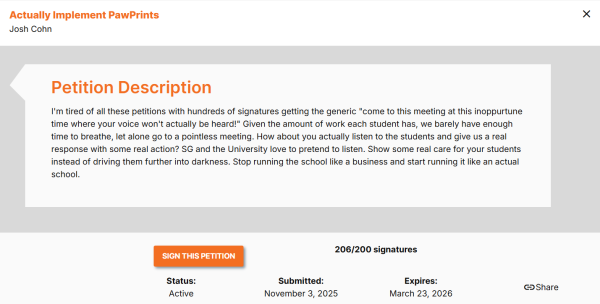
Due to time constraints, SG reviewed one PawPrint and will discuss the remaining petitions next week. A petition to “Actually Implement PawPrints” was charged to the Director of Student Relations. Hoopes mentioned having technical difficulties updating the PawPrints website, so the petition may not yet have the “charged” status online on the day that this article is published.
During a brief discussion on the petition, SG members concluded that students don’t feel like they are being heard. “This is a great opportunity to [share] how people can get involved,” SG President Gilboa said.
The meeting adjourned at 4 p.m. after two hours.