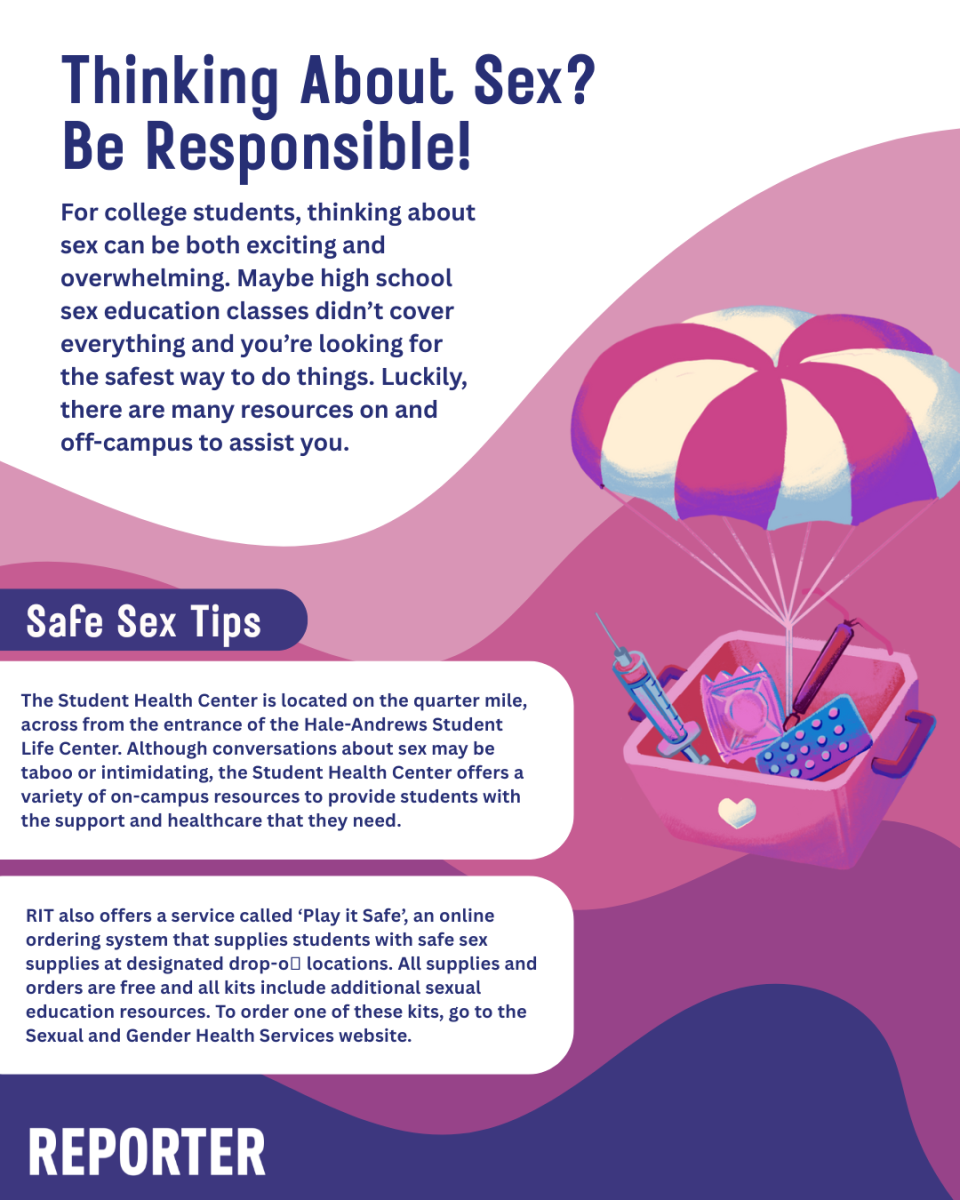
For college students, thinking about sex can be both exciting and overwhelming. Maybe high school sex education classes didn’t cover everything, and you’re looking for the safest way to do things. Luckily, there are many resources on and off campus to assist you.
Sexual and Gender Health Services at RIT:
The Student Health Center is located on the quarter mile, across from the entrance of the Hale-Andrews Student Life Center. Although conversations about sex may be taboo or intimidating, the Student Health Center offers a variety of on-campus resources to provide students with the support and healthcare that they need.
Unless you’re ready to be a parent, remember to wear a condom!
Available Contraceptives:
- Male condoms
- Female condoms
- Oral contraceptive pills
- Nuva Ring
- Intrauterine Device (IUD)
- Diaphragm
- A flexible device placed in the vagina and used with a spermicide each time before sex
- Depo Provera
- An injectable hormonal birth control given every three months
- Contraceptive Implant
- A small device placed in the arm to prevent pregnancy for up to three years
- Emergency Contraception
- Morning-after pill
RIT also offers a service called ‘Play it Safe’, an online ordering system that supplies students with safe sex supplies at designated drop-off locations. All supplies and orders are free and all kits include additional sexual education resources. To order one of these kits, go to the Sexual and Gender Health Services website.
Additionally, the Student Health Center offers a variety of tests after engaging in sexual activity. These include pregnancy, STI and HPV testing, as well as reproductive health resources throughout the course of a pregnancy.
Planned Parenthood:
Planned Parenthood of Central and Western New York operates nine health centers in the Rochester area and a mobile unit, offering in-person and telehealth visits.
In Monroe County, there are two locations:
- 114 University Ave., Rochester, 14605
- 2235 S Clinton Ave., Brighton, 14618
Planned Parenthood’s education department provides medically accurate, age-appropriate programs on sexuality, sexual health and relationships for all individuals. These workshops are hosted in schools, community centers and residential facilities.
Planned Parenthood offers prescriptions, emergency contraception and STI/HIV screenings regardless of insurance status. Their clinics welcome walk-ins and provide Spanish-language support. Planned Parenthood accepts Medicaid and other major insurance plans, but also offers low-cost options for uninsured patients. To make an appointment, call 1-866-600-6886.
Safe Sex Tips:
How to use a condom correctly:
- Pinch the tip to remove air; leave about an inch for semen
- Roll down the full length while holding the tip
- After ejaculation, hold the base and withdraw before losing erection
- Tie the condom, wrap it, and throw it away safely
Condom Tips:
- Use water-based lubricant inside the tip and outside to reduce breakage and increase comfort
- Store condoms in a cool, dry place — heat can damage the latex
- Condoms are not 100% effective, but significantly reduce the risk of STIs, HIV and pregnancy
Avoid High-Risk Behavior:
- Alcohol and drugs impair judgment and can lead to unsafe sex
- Serial monogamy (frequent short-term interactions) increases your risk of contracting an STI
Clearly Communicate:
- Talk openly and honestly with your partner before engaging in sexual activity
- Consent and mutual understanding are key to safe and respectful experiences
Other Protection Methods:
- Use dental dams or plastic wrap for oral sex to reduce STI transmission
- Use condoms even if you’re using another form of birth control
- Kissing, hugging, massaging and touching are lower-risk than sexual intercourse
Abstinence is the only 100% effective way to avoid STIs and pregnancy.
Many college students choose to delay sex, and that’s okay. If you’re not 100% sure, don’t do it.
Have fun and stay safe!