On Feb. 19, 2025, Harper Van Lare, a Psychology student at RIT, uploaded a petition titled “Clear paths OR cancel Classes” onto the PawPrints website.
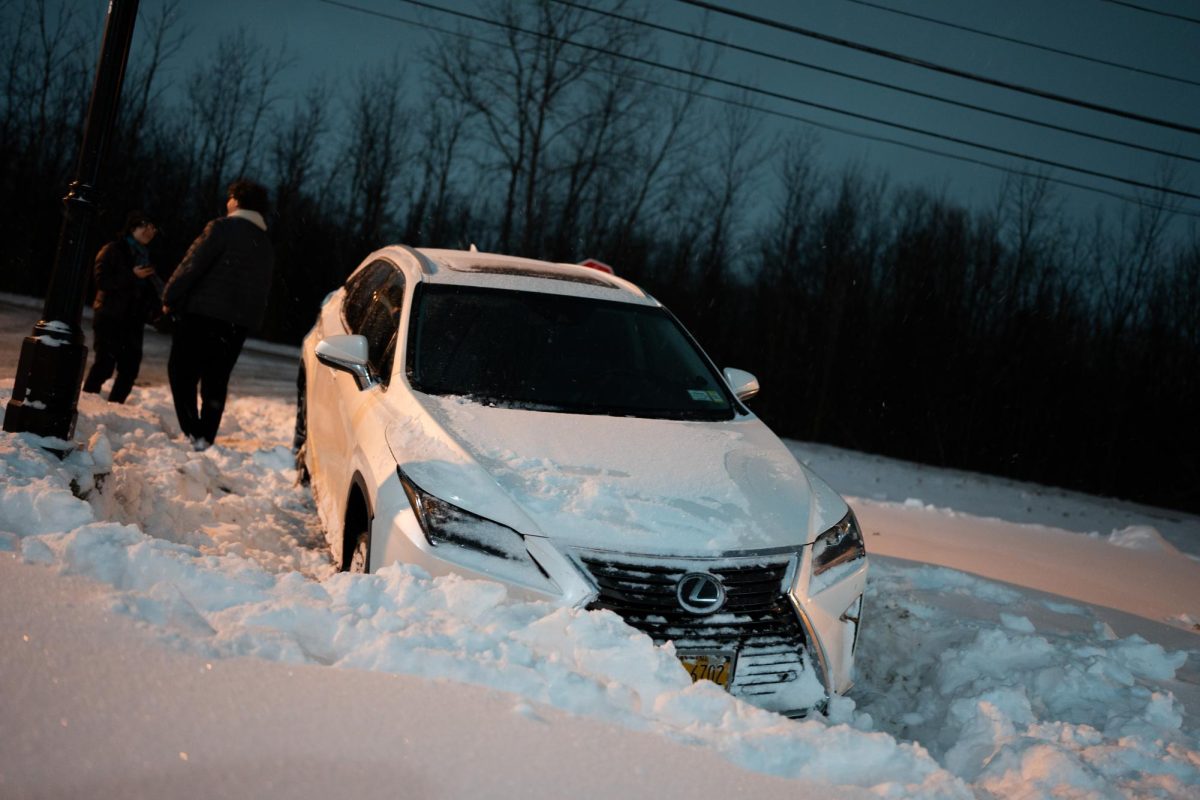
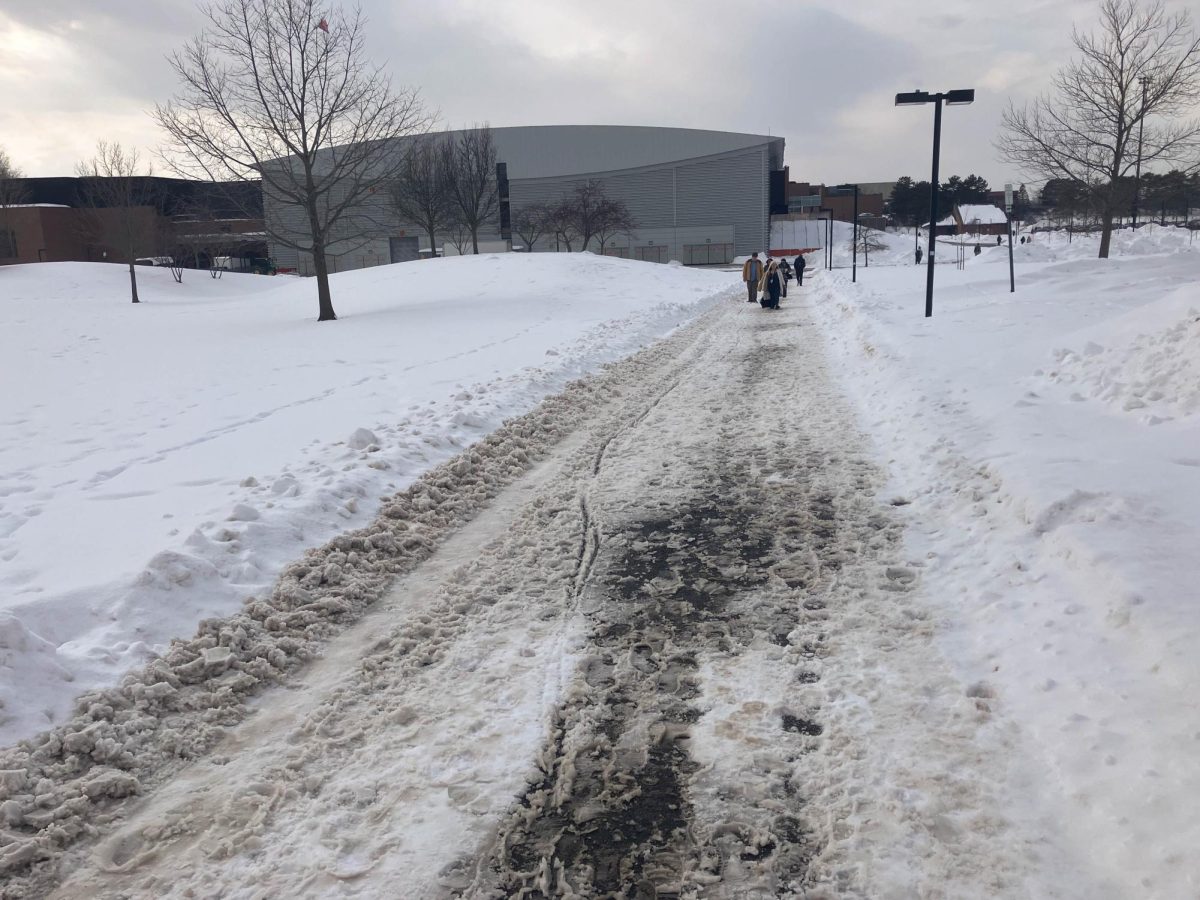
The petition opened, “Campus accessibility is horrid right now. Paths are covered in snow, ice, and slush, walking safely takes twice as long, and indoor floors are soaked.” Garnering 560 signatures, those words hit close to home for many RIT students.
RIT Student Government (SG) charged the petition to its Facilities, Parking, Transportation, and Sustainability (FPaTS) Committee. Yet, when students returned to campus after winter break in the spring 2026 semester, nearly a year after the PawPrint was published, they found themselves walking on slippery, uneven paths.
Did the PawPrint simply slip through the cracks? Not quite. On Nov. 10, 2025, Jameson Baker, SG’s FPaTS Committee Chair, updated the petition explaining that issues with snowy paths in the 2024-2025 school year can largely be attributed to a statewide salt shortage in New York.
Baker also added that “[when] exploring options during the shortage, it was determined that melted slush was a safer alternative to having things freeze over again, creating black ice.”
During the Nov. 21, 2025, SG Senate Meeting, a motion to close the petition failed, as many SG members felt that the update from FPaTS did not adequately address student concerns.
Student Concerns
For many students, unplowed paths can be a source of irritation during busy commutes. However, for a population of RIT students with mobility challenges, slippery or uneven paths can be seriously restrictive, or even downright dangerous.
Johnny Fuhrmann, a second year Biomedical Sciences student who walks with the assistance of forearm crutches, said, “[able-bodied people] know how much energy it takes to walk through heavier snow….[Now] double that with unstable joints, unstable ankles, an injury, a deformity…anything like that.”
Fuhrmann also reported that two of his wheelchair-using friends from the Disability Cultural Club (DCC) have gotten frostbite from operating their wheelchairs through thick slush following the Jan. 26, 2026, blizzard.
“[It happened to] two people, both wheelchair-users waiting for the AVS (Accessible Van Service)(…) [The slush] wicks into your gloves(…) AVS has had lots of issues with the snow day, so their rides kept getting delayed, and by the time they actually got into the van, their fingers were not working,” said Fuhrmann.
L Contento, third year Computer Science student and president of the DCC, corroborated the story, saying, “I’ve had a few [club] members get frostbite this season.”
According to Fuhrmann, the two friends went to the Student Health Center and did not suffer any permanent damage. However, the situation was described as frightening for them.
First year Chemical Engineering student Jacob Warner shared similar thoughts. Warner recently tore his ACL while skiing and had to be on crutches for four days. This happened to be the week before the Jan. 26 snow day, when many paths piled up with snow and slush. Despite Warner’s efforts to attend class, he found that the walk was too dangerous.
“Simply out of fear of causing further injury, I was unable to attend class for the four days that I was on crutches…. I slid about one foot on the first step I took out the door,” he explained. Warner is not alone; both he and Fuhrmann have missed classes due to inaccessible paths.
Warner communicated with his professors and explained why he could not attend classes. While he said two of his four professors were understanding and supplied recordings of lectures, the other two deducted points for the absences and provided no accommodation.
Contento mentioned that several members of DCC have experienced similar struggles and that the inaccessibility of paths has been a recurring point of discussion in their Discord server.
Notably, while unplowed paths affect the disabled population the most, those without significant mobility struggles have still reported problems.
“I am able-bodied and Deaf, and I don’t have a problem with mobility, but I’ve fallen three or four times already on campus,” said Savannah Brown, SG’s Cross-Registered Senator.
“[able-bodied people] know how much energy it takes to walk through heavier snow….[Now] double that with unstable joints, unstable ankles, an injury, a deformity…anything like that.”- Johnny Fuhrmann, second year Biomedical Sciences student
Committee Chairs
As of this article’s publishing, “Clear paths OR cancel Classes” remains open. One reason certain PawPrints may stay open longer is an imbalance in the number of petitions assigned to each committee. During SG’s Jan. 23, 2026, Senate Meeting, SG’s Director of Student Relations, Trishelle Hoopes, explained that about 50% of petitions get charged to the FPaTS and Student Affairs committees. To remedy this, Hoopes proposed restructuring current committees to make the workload more equitable.
The current division of work means that PawPrints charged to FPaTS often carry over between semesters. FPaTS Committee Chair Jameson Baker noted that when “Clear paths…” was written and charged, he was not yet Committee Chair.
Although the petition has been charged to FPaTS, Suprina Kabadkar, SG’s Accessibility Committee Chair, is working on the PawPrint from an accessibility perspective. Kabadkar is not a voting member of SG, but by voicing her concerns about the response that FPaTS issued, she contributed to the decision to keep the petition open.
When advocating for more work to be done on the petition, both Kabadkar and Baker have received similar responses from Facilities Management Services (FMS) explaining that the statewide salt shortage has been resolved and that slush provides more traction than ice.
On this, Kabadkar said, “The slush answer is not a good answer for the disability population…. I know that in their opinion, it’s safer, but for a population of RIT, it is certainly not.”
One able-bodied first year Computer Science student, Nehuel Armenanzas, agreed. “When it’s all slushy, I find it so much harder to walk.”
On top of being a slipping hazard on paths, heavy slush buildup can also become a slipping hazard inside buildings by soaking into the bottoms of pants and forming puddles in building entrances.
Baker agreed that his response to “Clear paths…” did not address the topic of disability. He expressed that he would like to do more work on the petition to improve accessibility, but he feels RIT has little interest in changing how paths are maintained. Baker explained that he feels “RIT struggles with gray areas,” and that unless an accessibility issue is an “immediate threat,” it is unlikely to be resolved.
Meeting with FMS
At the Feb. 2, 2026, Accessibility Committee Meeting, the Accessibility Committee hosted FMS’s Director of Facilities Services, Derek Sylvester, for a conversation about improving path accessibility in the wintertime. Students had the opportunity to share how slippery, uneven paths impact them.
According to Sylvester, there is not much more that the Grounds staff can currently do about the paths. He explained that when snowfall is predicted in the morning, the Grounds staff arrive on campus around 3 a.m.
“We’ve been working 12-hour days for 16 days straight,” Sylvester said. On one particularly snowy weekend, staff stayed at the RIT Inn and Conference Center instead of going home. “We rent rooms there so they can get a quick sleep; and when I say ‘quick,’ I mean maybe four hours, and they’re right back at it,” he added.
The current Grounds department consists of only 10 permanent employees. Regarding this, Sylvester commented, “You look at St. John Fisher, which is much, much smaller— literally a tenth the size of [RIT], and they have nine [Grounds employees] for their campus.” Sylvester has advocated for hiring more staff members in the past with little success.
SG’s Cross-Registered Senator, Savannah Brown, suggested allowing students to help maintain paths for volunteer hours. She noted that she would be willing to pitch in herself, to which other students present at the meeting agreed. Sylvester mentioned that he intends to bring this idea to the Center for Leadership and Civic Engagement.
Kabadkar told those at the meeting that she would do more research and advocate for more Grounds staff. She also intends to contact the Disability Services Office (DSO) to suggest online alternatives for students with mobility issues who cannot make it to class on snowy days.
Conclusion
Some students may blame groundskeepers for slippery paths. One able-bodied respondent to an anonymous Reporter survey said, “[They] shovel poorly and the slush makes it nearly impossible not to slip.” It’s important to note that FMS and the Grounds Department insist they are doing everything they can to maintain the paths, with only 10 permanent staff members.
Others may blame SG. There is a current sentiment shared by part of the RIT population that SG does not listen to students, made evident by a recent petition titled “Actually Implement PawPrints” reaching over 200 signatures. It is crucial to highlight that both the Accessibility and FPaTS Committees have shown interest in improving path conditions for RIT’s disabled population, but those committees can ultimately only succeed by working with professional staff.
Despite SG and FMS’s efforts, many disabled students believe they are still not receiving adequate support on days when campus is less accessible.
FPaTS Committee Chair Jameson Baker encourages students to show up to committee meetings and get involved. While writing and signing petitions is instrumental, student involvement can demonstrate the scope of a problem to professional staff. Students who are unable to attend are encouraged to reach out to Committee Chairs via email. Meeting times and contact information can be found on SG’s website.
Students looking to support “Clear paths…” or to suggest ideas can contact Baker, Kabadkar or Sylvester from FMS. Students can also write petitions that address other related problems, such as the size of the Grounds team. Despite resources such as Committee Chairs and PawPrints being available, students likely must advocate for this cause if they wish to see change.