
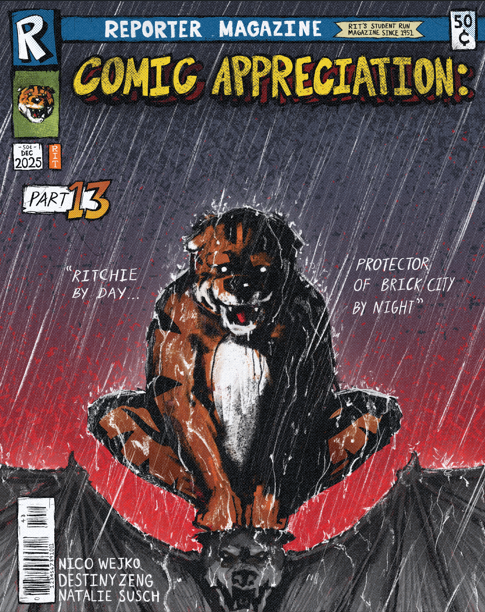
Comics are a form of political activism, an expression of thoughts and a forum to spread ideas over the years. First rising in popularity in the 1930s and 40s, comics were created in opposition to the extreme propaganda of this era. During World War II, there was extreme nationalism and fascism across the globe. Comic artists were speaking out through their art, creating superhuman heroes who crassly punched Nazis, such as Captain America. Comics went beyond just fighting Nazis. These storylines had many underlying themes; Superman championed pro-immigration and workers’ rights messages, while Batman was fighting corruption from within, resonating with large cities such as Chicago and New York City. These were superheroes for the people.
Comics are frequently excluded from traditional classifications of literature, but this exclusion is misguided. Within the pages, there is more to take from than just entertainment, and the Cary Graphic Arts Collection in RIT’s Wallace Library is a strong reminder of that. Included in the collection is the Graphic Design Archive, a display of mini-comics, a mural of comic book art and small history lessons in the comic world. Throughout the displays, most displays have plaques emphasizing the importance of minicomics, self-publishing and eventually the Comic Code Authority (CCA).
According to the Cary Collection, the CCA approved comics as non-graphic and “safe” for readers if they followed specific guidelines, such as “All lurid, unsavory, gruesome illustrations shall be eliminated” or “profanity, obscenity, smut, vulgarity, or words or symbols which have acquired undesirable meanings are forbidden”. Its establishment was a response to a rise in more explicit content, intended to promote “wholesome and reader-friendly” comics. While this allowed readers to avoid more adult material if they wished, it still represented a level of censorship. Over time, the CCA became less important, and most major publishers had dropped the seal by the early 2000s. Even without the CCA, censorship exists within the media; one of the most commonly banned books in America is a graphic novel, “Gender Queer”.
The year 2025, compared to previous years, has featured many different superhero films. Strictly looking at global revenue, “Superman” (2025) has made $616 million in only three months. “Man of Steel” was released 12 years ago and has made a total of $667 million. It took “Superman” roughly two percent of the time of “Man of Steel” to almost match its total revenue. Looking at Rotten Tomatoes scores instead, “Man of Steel” was rated 57 percent, compared to “Superman”’s 96 percent. Not only was “Superman” critically acclaimed, but it held messages that are quite stark in comparison to the year of release. The film includes strong pro-immigrant themes, emphasizing the idea that ‘no human is illegal.’ This message is particularly striking in the context of 2025, a year in which there has been an accelerated uptick of immigration-related arrests and removals. In the midst of the year, Superman offered hope for a kindhearted and empathic future.
This is the purpose of superheroes, including Superman. They are created as beacons of light, embodying the best of us, yet they could be any one of us. They are fictional, their stories exaggerated, but they are meant to inspire us, to show that there is good in the world; that we can be that good. While comics and superheroes both have evolved over the years, their defining reason to be remains untouched by the passage of time.



The Orb • Dec 18, 2025 at 10:30 pm
Oh this is lovely