

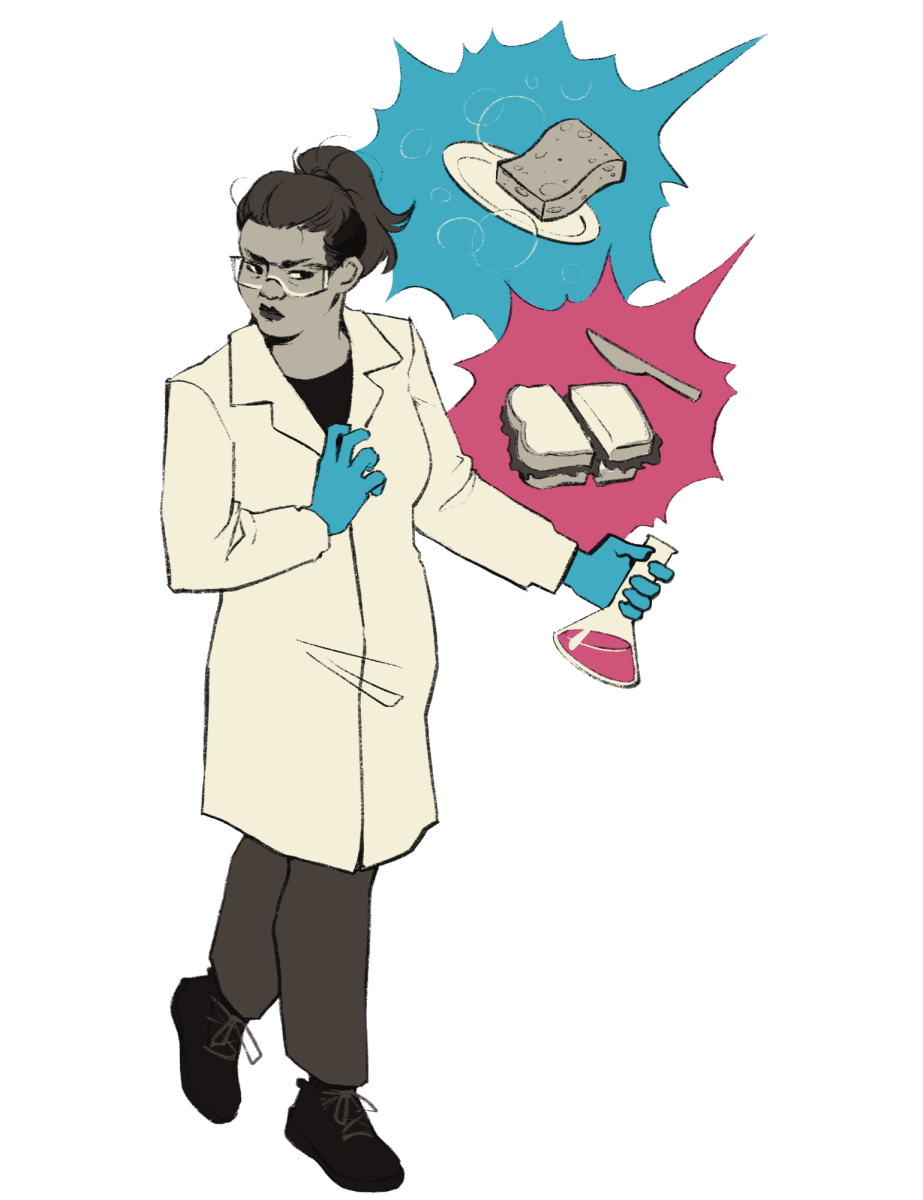
Have you noticed misogyny in your field? RIT has a 65 percent male student population, which results in many programs being male-dominated. Female students in STEM programs often experience misogyny from peers and faculty.
RIT has taken strides to ensure that women are included in STEM spaces. Halley Deme, a fourth year Biotechnology and Molecular Science major, shares her experience. “Dr. Kate Wright — who is, I think, the Head of Life Sciences — is very approachable and she seems very on top of stuff like this and as well as Dean Hudson, and he’s very pro-minorities of all types, so I feel generally supported.”
There is also the Women in Science and Math (WISe) program, located within the College of Science, which offers opportunities for women to gain relevant experience in science. However, those achievements — while remarkable — may not be enough to spread awareness and reduce misogyny.
Misogyny Defined
In male-dominated fields, women are often subject to misogynistic attitudes. Kate Manne, an Australian researcher and creator of several books researching misogyny, argued that ‘misogyny’ cannot be defined as simply woman-hating, but as a weapon utilized by sexism to reinforce a patriarchal system.
Sexism is used by both men and women as a tool to regulate women’s behavior through the lens of what is expected of them. Examples of misogyny include demeaning language, microaggressions, sexual objectification and in severe cases, physical and sexual violence. Manne clarifies that the term “misogyny” does not always mean that men hate women. Most misogynistic men love their mothers, sisters, wives and daughters — and still perpetuate misogyny.
Women of color also face misogyny through the lens of intersectionality. A word created by Kimberlé Crenshaw, intersectionality refers to the intersection of identities and explains how not all people experience oppression the same way. Black women experience sexism differently from white women and racism differently from black men.
It is critical to emphasize that intersectionality requires race. Intersectionality focuses on the experience of people of color who also possess a marginalized identity, such as sexual orientation, gender identity, religion or disability. An example of an intersectional experience in the lab is a Black woman being told that their hair is unprofessional and untamed. To describe experiencing this double oppression without utilizing race, one should use the term simultaneity.
Transgender individuals, of course, aren’t left out of the equation. Transgender women often experience a unique subset of misogyny. First coined in 2007, the word transmisogyny is used to explain the simultaneous experience of transgender women. They often experience double oppression, based on their gender and being transgender. Black transgender women often experience triple discrimination based on their gender identity, race and being transgender.
RIT Programs
RIT boasts over 100 STEM programs in both graduate and undergraduate fields. Some programs have a higher female-to-student ratio — often because of social stereotypes. The College of Health Sciences and Technology (CHST) has a 79.8 percent female student body. CHST has programs that are considered socially “female-coded,” such as Diagnostic Medical Sonography.
Jenny Barton, a fourth year Biology major, shares her experiences as a woman in labs. “I have had male lab partners tell me to wash the equipment or get the reagents or supplies instead of asking me to help with the actual experiment. It almost translates to washing the dishes and getting the groceries.”
The biology program has a gender ratio of 2.3 female professors to male professors. “I think there is a good balance of female teachers in my classes that makes me feel more supported as a woman in STEM,” Barton said.
In fall 2024, the RIT undergraduate cohort had 338 Black female students, who make up around 2.6 percent of the undergraduate body. Black women face unique challenges in the laboratory. Deme recalls her experience working in labs as a black woman.
“I think generally [white female classmates] are just easier to get along with or easier to work with, so I have noticed that they won’t get yelled at or criticized for the same thing that I’ve done. Like one time in a lab, it was three of us, and I was the only black girl — and the other two girls were white — and I think we all forgot to clean something up or something, but I was the only one who got called out. And I did go to Dr. Kate Wright about this professor, because it seemed to be a repetitive issue where we all forgot to clean something up or something, but I was the only one who got called out.”
In a 2021 article titled Sexism persists in STEM, the Society of Women Engineers states that female graduates from 2017-2018 represented about 21 percent of bachelor’s degree holders, 29 percent of master’s degree holders and 24 percent of doctoral degree holders in STEM fields. Kate Gleason College of Engineering follows closely with the national average, with around a quarter of its student body being female.
Women — who are theoretically half of the population — represent a minority in a profession that is important to protecting human lives. In a 2019 article by the Guardian, women are 47 percent more likely to be seriously injured in a car crash compared to men. This is because in crash tests by automotive manufacturers, they utilize crash dummies that are modeled after men’s weights and bodies, omitting women’s smaller frames. Having more women in STEM workplaces can save women’s lives.
There is still a long way to go to reduce misogyny in STEM programs and professions. The best way to combat misogyny is to ensure that you’re staying aware of the different ways that misogyny can manifest itself in the workplace. Being a proactive voice when you notice that something is misogynistic, either by default or by design, can contribute to a safer and equitable workplace.
*Quotes edited for clarity purposes.






The Orb • Dec 18, 2025 at 10:29 pm
Shares a stat indicating a bias towards hiring more female professors in the biology program…
“I think there is a good balance…”
I love seeing the only genuine indication of bias in the field is actively anti-male.