

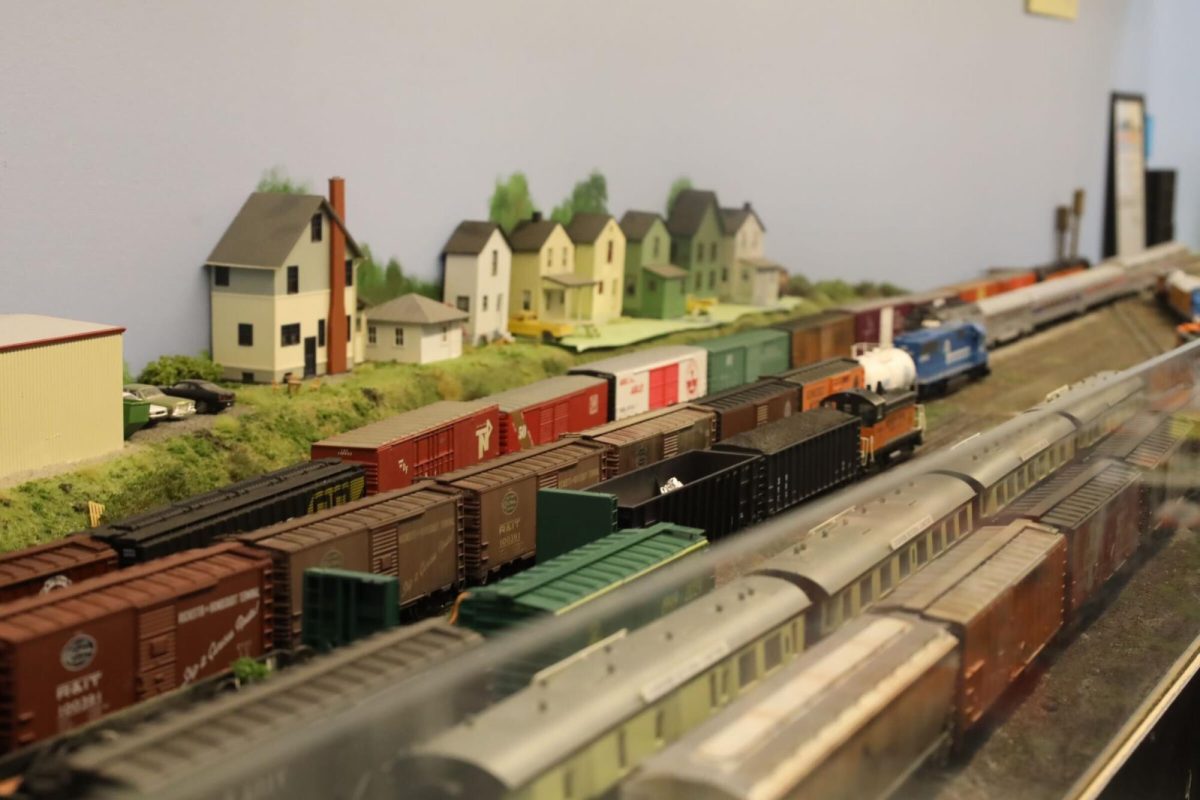
On Oct. 18, Garett Lester — coordinator for RIT Model Railroad Club — posted a petition on PawPrints titled “Save The RIT Model Railroad!” It stated, “After almost 30 years in the SAU, the RIT Model Railroad Club is faced with destruction. The Center for Campus Life has notified us that we are being forced out of our room, and that we have less than 60 days to dispose of 50% of our club’s materials.” Exactly a week later, on Oct. 25, the RIT Anime Club and Tora-Con made a similar PawPrint. Their petition stated that they would also be forced to get rid of 50 percent of their materials and required to move out of their room altogether by March 6.
The problem of club spaces has been an ongoing issue this last month, with four different clubs directly affected by Campus Life’s policy crackdowns: Model Railroad Club, Anime Club, Amateur Radio Club and the Rochester Wargamer Association and Guild.
Sara Bayerl, the Senior Associate Director for Engagement in Campus Life, explained that the changes were a result of their attempts to ensure that all clubs were getting equal access to resources. “What we’re working to do is align all of our policies and make sure… there’s no one club that has a space where other clubs don’t have the opportunity to.”
Bayerl elaborated that Campus Life usually only allocates campus space to “major club organizations,” for example, the College Activities Board or WITR radio. However, they do not feel they have the space in the Campus Center to allocate enough space for other Campus Life-recognized clubs. In the past couple of years, Campus Life has been consolidating spaces from “outliers” who had previously been given more than other clubs. In the process, they are attempting to organize their storage spaces, as well as “to streamline a process of shared storage for our clubs.”
Bayerl also emphasized that Campus Life is responsible for supporting 287 different clubs.
“We are supporting every single one of their events,” she said. “We’ve had probably our highest semester ever of student organization events that we’ve been able to help support and approve.”
Campus Life’s decision will make operations especially difficult for at least two of the clubs currently being affected by these changes: Anime Club and Model Railroad Club. It will likely irrevocably change their inner workings, and it may erase at least one of them from existence entirely.
James Wilkinson, a second year Mechanical Engineering student who’s been in the Model Railroad Club for both years, expressed concern for the status of club meetings if their space is downsized. “If we move to a space half the size, we’d have to tell half our club members to meet outside.”
Additionally, getting rid of 50 percent of their club materials would mean getting rid of the very things their club was created to preserve. The club is financially independent and funds itself through donations and its annual Tiger Tracks Train show. This show is the second-largest student-run event on campus, with over 2,000 yearly attendees. However, without the room and the train layout within it, the show may come to an end.
The Model Railroad Club PawPrint states, “Our request to the administration is simple. We have no need of funding, resources, or equipment. We simply request that they allow us to continue to operate in the room we have occupied since 1997.”
Though the Anime Club’s situation is different from the Model Railroad Club, given that they don’t have an entire model railroad to keep running, they will still face similar struggles without a location to keep their materials.
“They kind of sprung [these changes] on us,” said Destinye Yamada, the president of Anime Club. “They asked what things were used and not used, because they were going to have everyone move out of their rooms.”
For her and the club, the issue is determining how to downsize when the majority of their items are frequently in use. The club stores items that are often used in Tora-Con, the annual anime convention they run. This two-day event is the largest anime-culture convention in upstate New York. They also store out-of-print magazines, DVDs, books, VHS tapes, awards and various other historical items (although in the past few years, they were told they could no longer keep these in the storage room due to safety concerns). They loan out many of these items to the student population during their weekly Monday library hours.
They additionally meet on Tuesdays for a casual hangout called Maker’s Meetup, on Thursdays for main events and on Fridays for planning, with the occasional official event scheduled afterwards. The club sometimes meets on the weekends for special events like model kit jamborees, games, karaoke, barbecues, movies and other activities. Some club members come to all of these meetings every week, while others have more specific preferences.
Yamada stated, “A lot of us don’t have much trust in Campus Life. A lot of times we do stuff on our own, and then they come in and give us new rules with things to work around.”
Similar to the Model Railroad Club, the Anime Club is fully financially independent. They also generally profit from Tora-Con, and after reinvesting the necessary amount into preparations for the next year’s event, they invest the rest of their earnings into the Rochester community. According to the posted Pawprint, “Last year, over half of the $9,000 donated to GRASP (Greece Residents Assisting Stray Pets) during our Winter Charity Auction came from Tora-Con proceeds. Hundreds have also been donated to RIT departments and organizations for their own events.”
With these new changes, however, Tora-Con may be in danger. Anime Club needs its storage space to hold vital materials that make the event possible, and Yamada said the removal of 50 percent of their items could result in Tora-Con ending for good.
“We’d really like to keep running things the way they’re run,” stated Yamada. “All the things we have are important to us.”
Whether Campus Life can accommodate these requests for continued storage space is also an issue. It’s possible that the problem is not simply a decrease in the flexibility of Campus Life rules, but the lack of increase in on-campus space allotted to student organizations as the RIT student population continues to grow.
“We actually only recognize clubs [if] we can meet their needs now,” Bayerl explained. “We want to make sure that we’re not setting clubs up for failure… and sometimes we have to work through change management.”




Rachel T • Nov 21, 2025 at 7:41 am
If this news upsets you, write an email Campus Life. Share your outrage (respectfully) and let them know that their disregard for the needs of their students is unacceptable. Even if it may not directly affect you, make sure they can’t ignore this issue.
I was a director for Tora-Con for 3 years. While some specific Campus Life members have been extremely helpful in preparation for the con, the majority of Campus Life has continuously made things more difficult to run Tora-Con. Sometimes staff has to completely change direction in the middle of the year to adjust for the arbitrary rules suddenly set up by RIT.
The arguments given by Bayer hold no water. Some clubs need more resources than others (like storage). In a world where cost of living is constantly increasing, RIT Anime Club is able to give its members a chance to enjoy exploring the world of anime and manga for free or little cost, in the case of movie outings. I’m sure the other clubs affected do exactly the same thing.
Bert Koenig • Nov 20, 2025 at 9:56 am
I asked AI for some help with composing this letter, Which seems somewhat meta in itself.
Write a justification for why a technology university such as RIT should continue to support their Model railroad club in a world increasingly becoming AI
Rochester Institute of Technology (RIT) should continue supporting its Model Railroad Club because the club provides a crucial environment for students to apply and integrate the very hands-on, interdisciplinary, and problem-solving skills that are essential for success in an AI-driven technology world.
Bridging the Gap Between Theory and Practice
While AI excels at data analysis and automation, innovation still requires human ingenuity, critical thinking, and the ability to work with physical systems. The Model Railroad Club provides this vital link:
• Tangible Engineering: Students can immediately apply classroom theory in areas like electrical engineering (wiring complex layouts and control systems), mechanical engineering (designing and maintaining rolling stock), and civil engineering (infrastructure design and construction) to a real-world, physical project.
• Systems Integration: Building a comprehensive model railroad involves integrating diverse components—electronics, software (DCC control systems), and physical infrastructure—mirroring the complexity of modern, large-scale systems in industry, including actual railway operations.
Developing Essential “Human-Centric” Skills
In an age where AI can handle repetitive tasks, skills that augment human capabilities become paramount. The club fosters these non-automatable skills:
• Complex Problem-Solving: Troubleshooting issues that inevitably arise in a large, intricate layout—from track alignment to signal malfunctions—requires deep critical thinking and creative problem-solving, skills that AI cannot fully replicate.
• Collaboration and Leadership: The club’s multi-decade projects require teamwork, communication, and project management skills, as students work together to plan, build, and operate the system.
• Creativity and Design: From scenery design to historical research and custom part creation using modern tools like 3D printing, students exercise creativity in ways that complement the computational efficiency of AI.
A Platform for Experiential AI and Innovation
The club can serve as an on-campus laboratory for “experiential AI” by providing a platform for students to test and apply emerging technologies:
• AI Integration: Students can explore using AI to optimize train schedules, manage energy consumption, automate signaling systems, or even apply computer vision for track inspection, directly leveraging their RIT education for practical innovation.
• Future-Proofing Talent: The skills in data governance, cybersecurity, and ethical considerations inherent in large-scale system management are critical for future railway operations and broader technological fields.
By supporting the Model Railroad Club, RIT validates its commitment to the blend of technology, arts, and design, and ensures its students are not just users of AI, but holistic, well-rounded innovators capable of shaping the future.
anonymous • Nov 21, 2025 at 9:19 am
I don’t really feel like this is relevant to the article at all. It undermines the importance of the human aspect of these clubs. This article has nothing to do with AI. Students need these clubs to be successful because they create a community and sense of belonging. Some clubs need more resources than others. I don’t think it takes an AI chatbot to come to that conclusion.
Bert K • Nov 20, 2025 at 9:45 am
Hard to believe, actually unbelievable that with all the massive building and construction that RIT undertakes that there hasn’t been a few hundred square feet of space allocated towards club activities. This all just seems to be a fairness feelings issue.
BSEE 1993 MSMM 1997
Nick S • Nov 19, 2025 at 9:09 am
Am I the only one who thinks it’s odd that the two clubs that are the least dependent on the university are among the ones being hit the hardest? It’s also weird that being financially independent from the university and still being able to put on large and successful events every year does not seem to be enough to qualify you as a “major club organization.” I also don’t believe Beyerl’s statement that Campus Life is “supporting every single one of their events.” Why then are they doing the one thing that would hamstring these clubs’ abilities to put on their events in the future?
Model railroads are not typically designed to be moved, and storage space for a convention is a necessity. These clubs also play host to archives of historic material, and it sounds like these clubs are being forced to get rid of things that can’t easily replaced (if at all) and that Beyerl and Campus Life couldn’t care less. Even if that’s not the case, they’ve done a pretty good job of making it look that way.
They also seem to have forgotten that people make enrollment decisions based on the clubs and student organizations on campus. If Campus Life is now in the business of shuttering these groups, they would be driving students away who might otherwise have enrolled.
Matt L • Nov 18, 2025 at 5:32 pm
Equal access to resources doesn’t make any sense when different clubs don’t have the same needs. It’s not like the Rubik’s Cube Club has any need for a space, just like Model Railroad Club doesn’t need money. The clubs office needs to meet the individual needs of each club, not some one-size-fits-all solution.
Allister Gainey • Nov 18, 2025 at 1:22 pm
Bayerl’s comments frustrate me, and they come across as either ignorant or clueless to the history, relevance, and importance of the clubs on campus. Equality sounds great on paper, but this should not come at the cost of organizations that have spent 30 years building up their identities (both Railroad and Anime clubs have been present since the 90s).
I remember prior to the SHED being built, there was a promise of it being able to provide additional club space (or sections of the Library being used as such). It’s a shame (but no surprise) that that fell flat entirely. If spacing is the apparent issue, then assistance needs to be provided to affected clubs so they aren’t required to downscale in such an extreme manner. If the rumor of SAU needing rennovations is the issue, then be honest and say so.
Shame on everyone at RIT who thinks this is a good idea.